Close
Type at least 1 character to search
Back to top

BIOGRAPHY

FIRST STEPS IN PICTURES

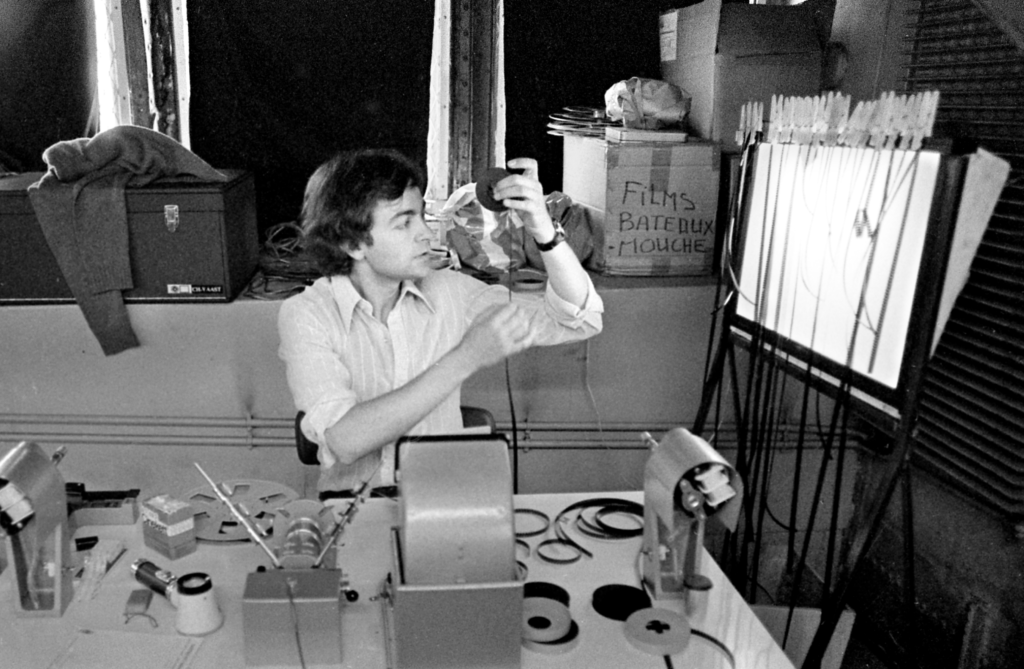
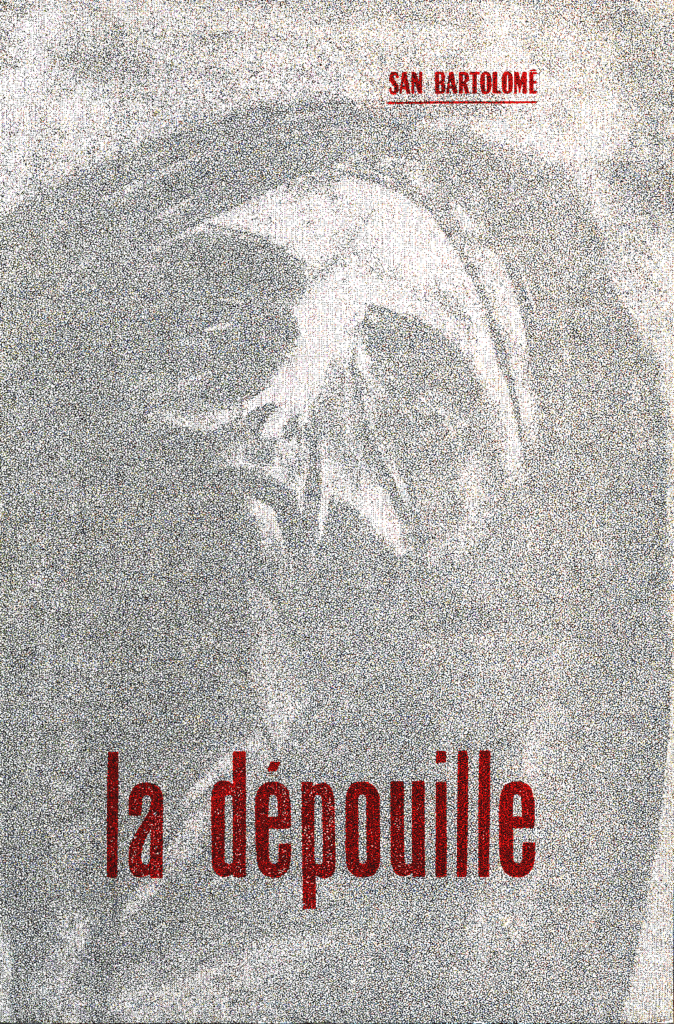
Alternating Law, Literature and Cinema studies, San Bartolomé publishes a book of short-stories La dépouille (1969), writes and directs an opera-verb Caligula (1971), curates a Jean Cocteau exhibition and directs his first film, in Super 8 formatDialogue Interrompu (1972).

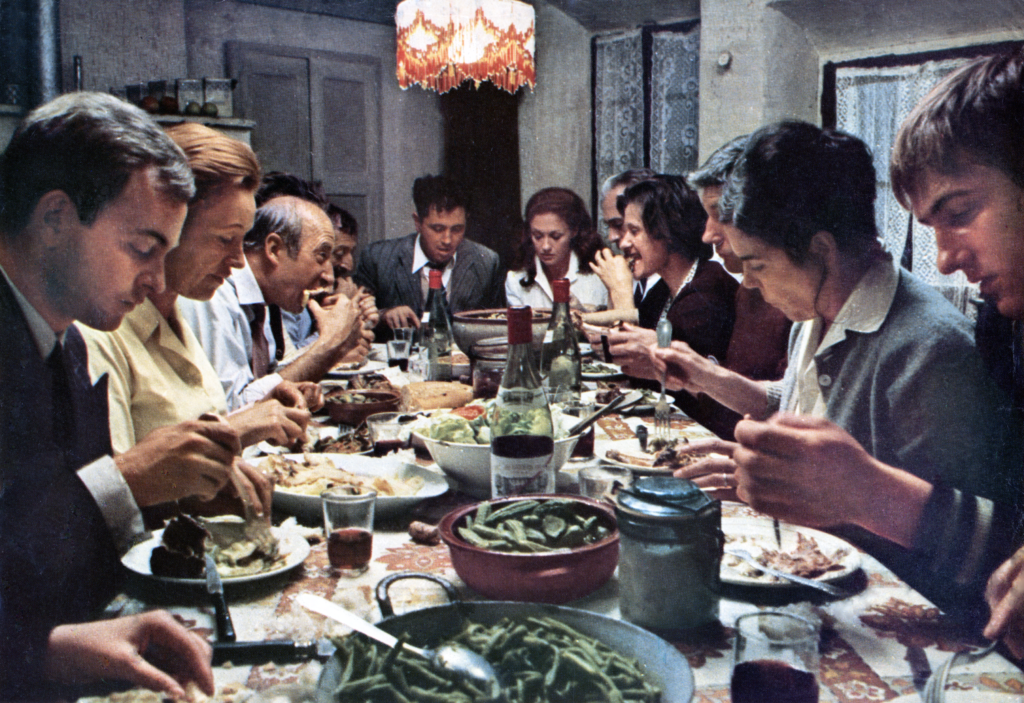
Hired as technical manager on the film L’affaire Dominici, with Jean Gabin – shot on the original crime scene – San Bartolomé appears at the “patriarch’s” table facing Gérard Depardieu of which this is one of the first film roles.

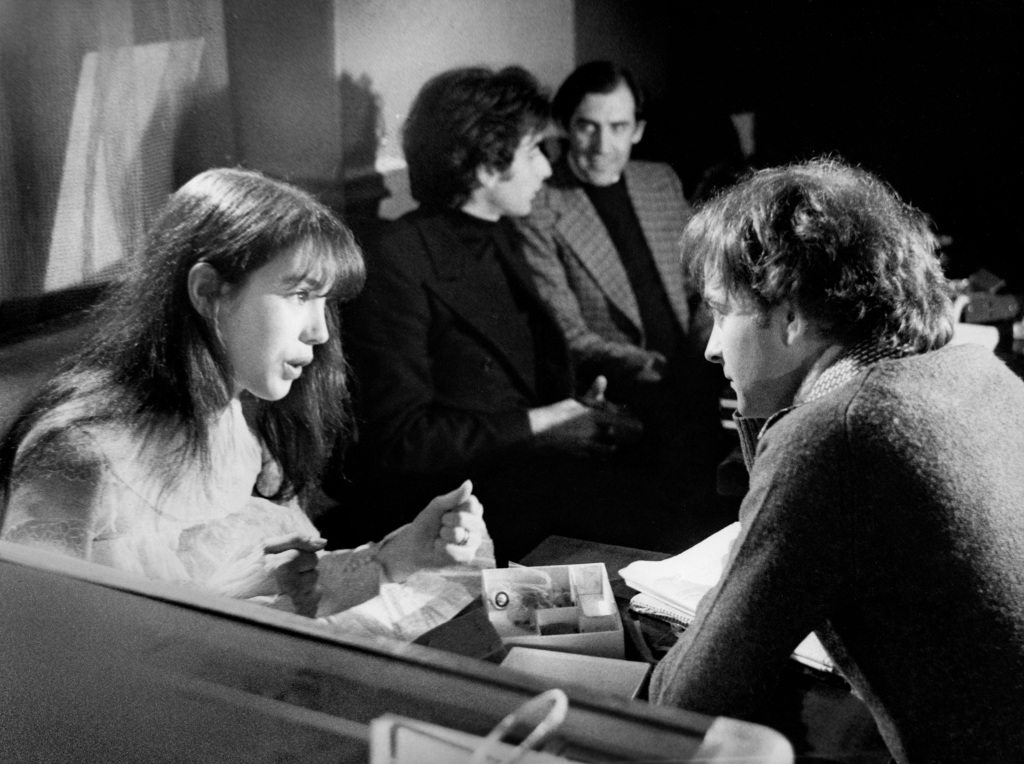
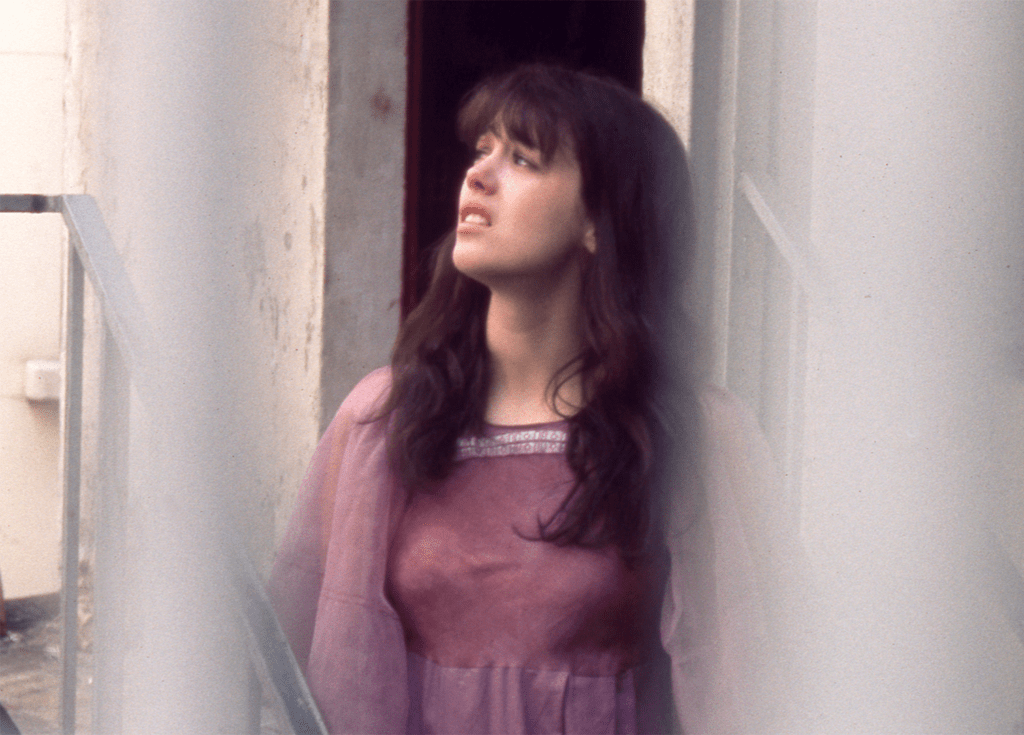
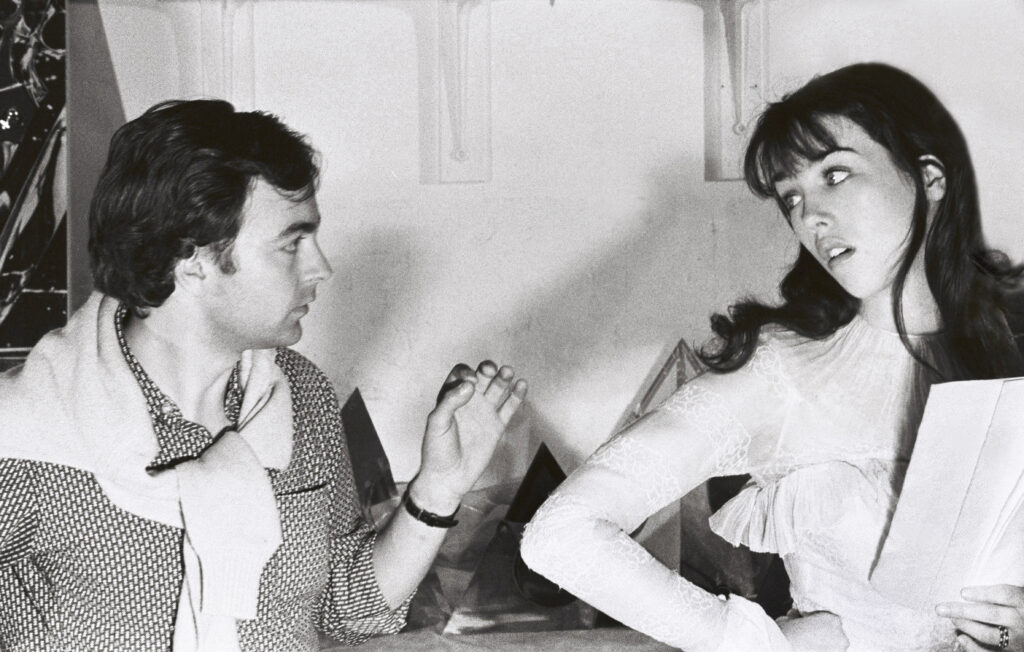
The shooting continues in Paris, an occasion for San Bartolomé “to go up to the big city” and stay there… He meets Isabelle Adjani  for whom he writes a film script – and her agent, Serge Rousseau, as well as Philippe Dussart, Alain Resnais’ producer. The birth of an eternal friendship with Isabelle…

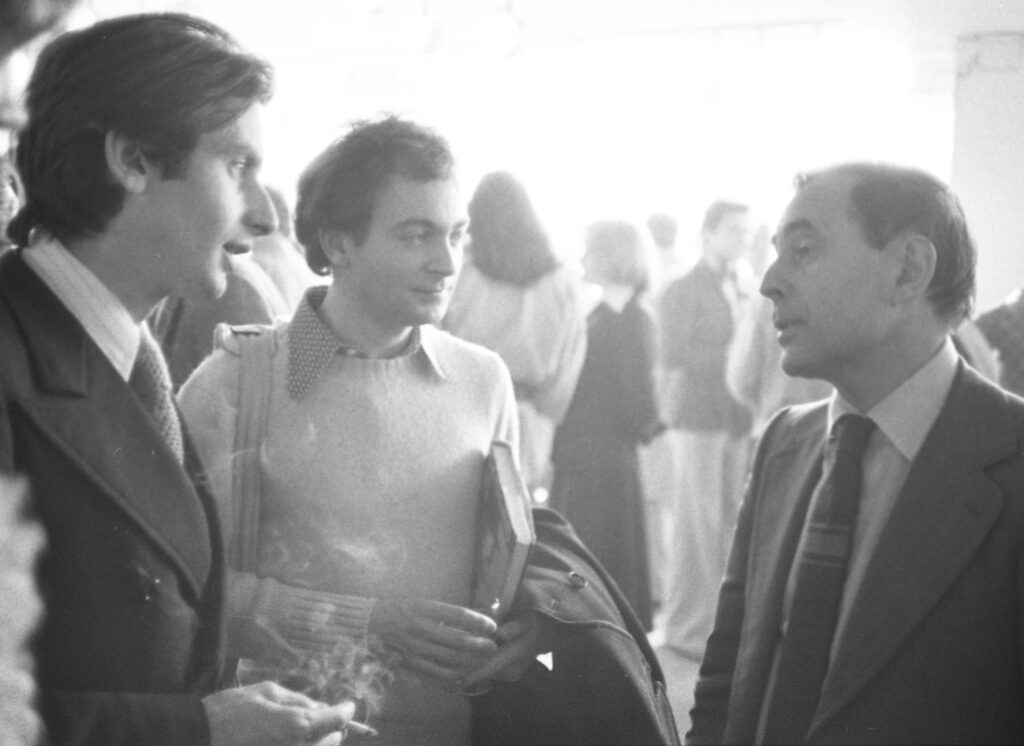
Dialogue Interrompu is programmed by the Modern Art Biennale at the Palais de Tokyo. Jean de Rigault, Artistic director of l’Espace Cardin, attends the screening and presents him to Pierre Cardin. The beginnnig of a lengthy collaboration and friendship with the stylist, fashion-designer and philanthropist.

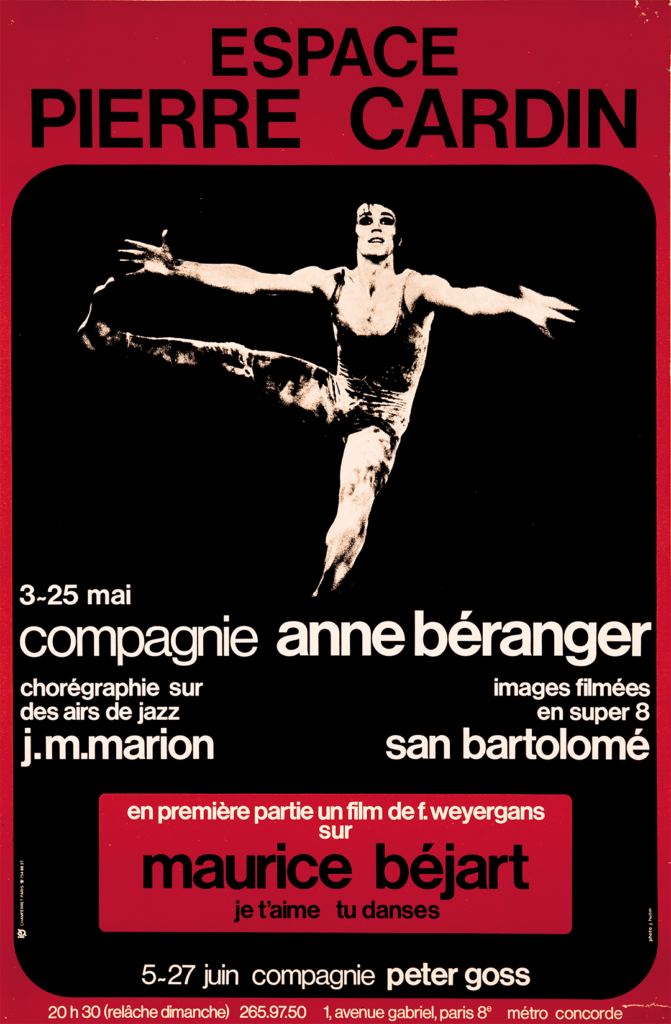
The young film-makers have put all their hopes in Super 8 Film, a cheap means of expression when video is just in its first stages of development. San Bartolomé shoots his film in Super 8, with triple screens, for the Anne Béranger Contemporary Dance Company (Espace Pierre Cardin May 1973).

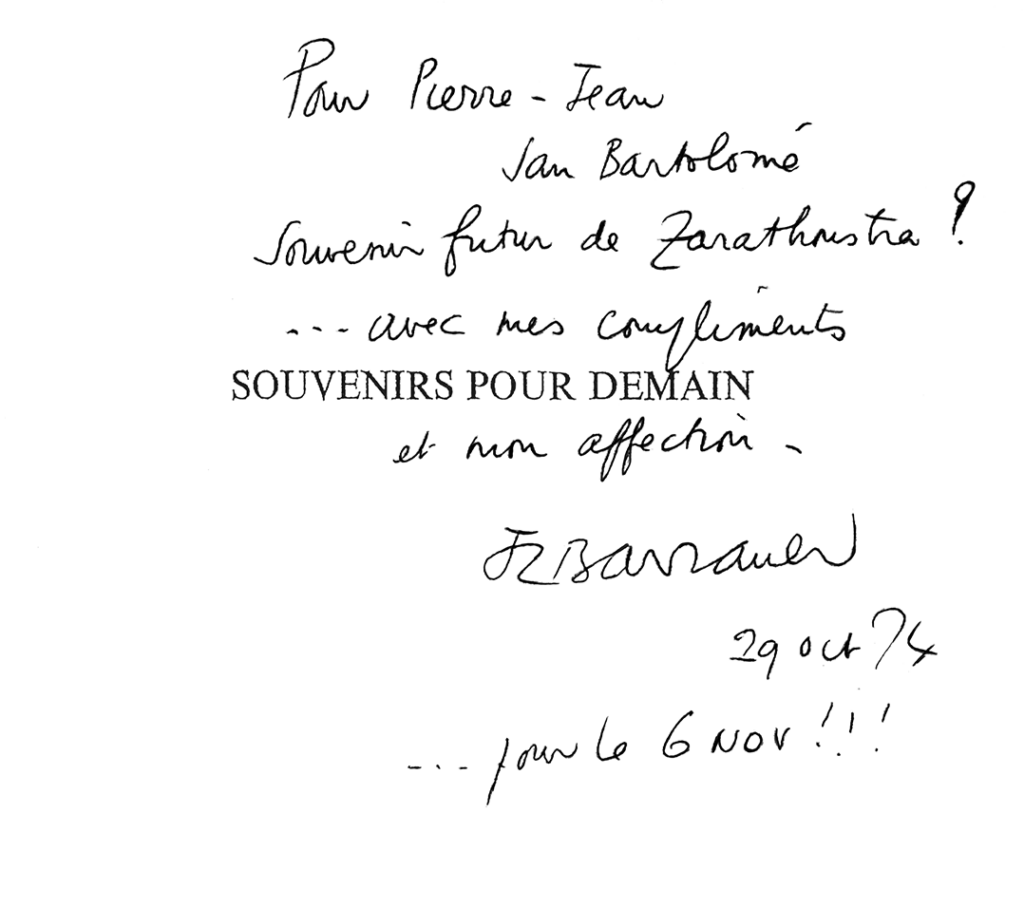
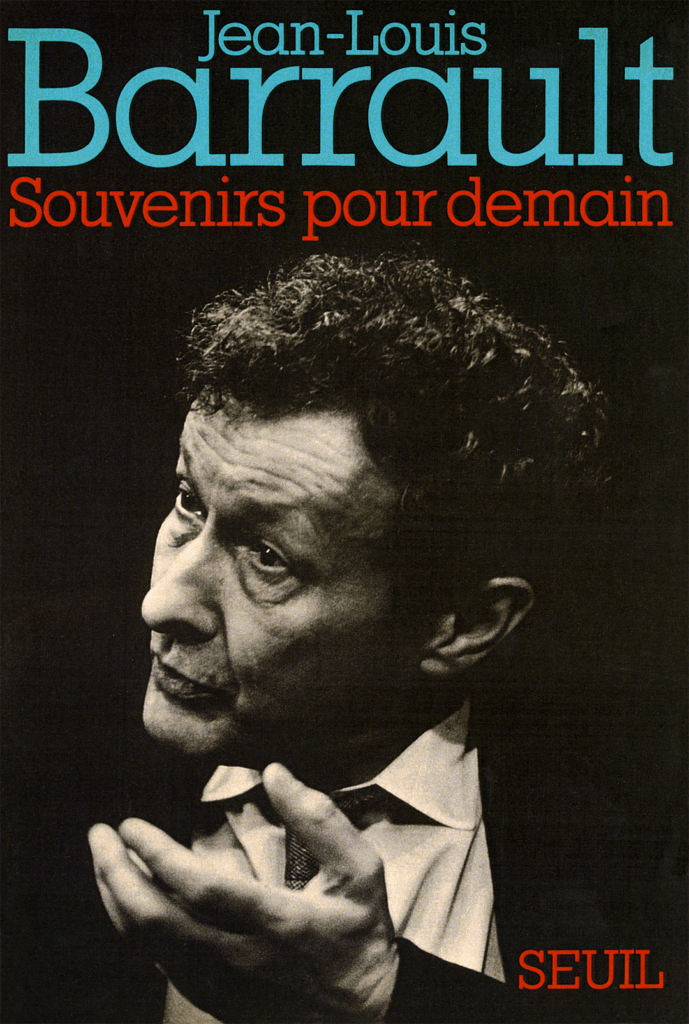
He creates the filmic interventions, conceived for 7 screens, of Jean Louis Barrault’s Ainsi parlait Zarathoustra (Théâtre d’Orsay, Compagnie Renaud-Barrault, November 1974). That same year, Madeleine Renaud gives a radio reading of two of his short-stories from his book La dépouille.

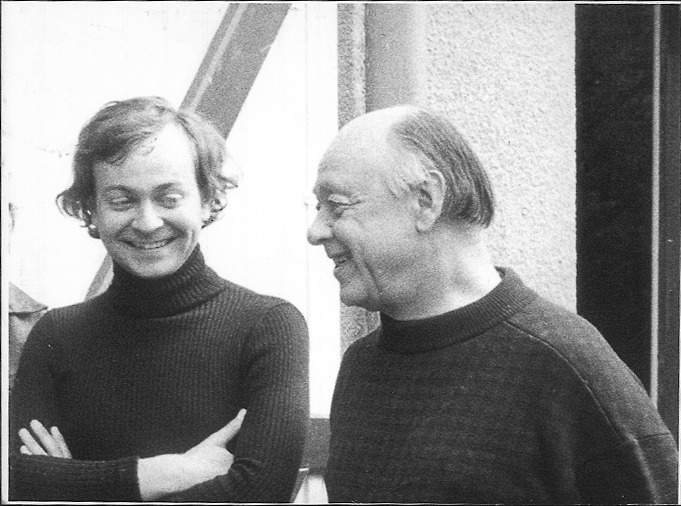
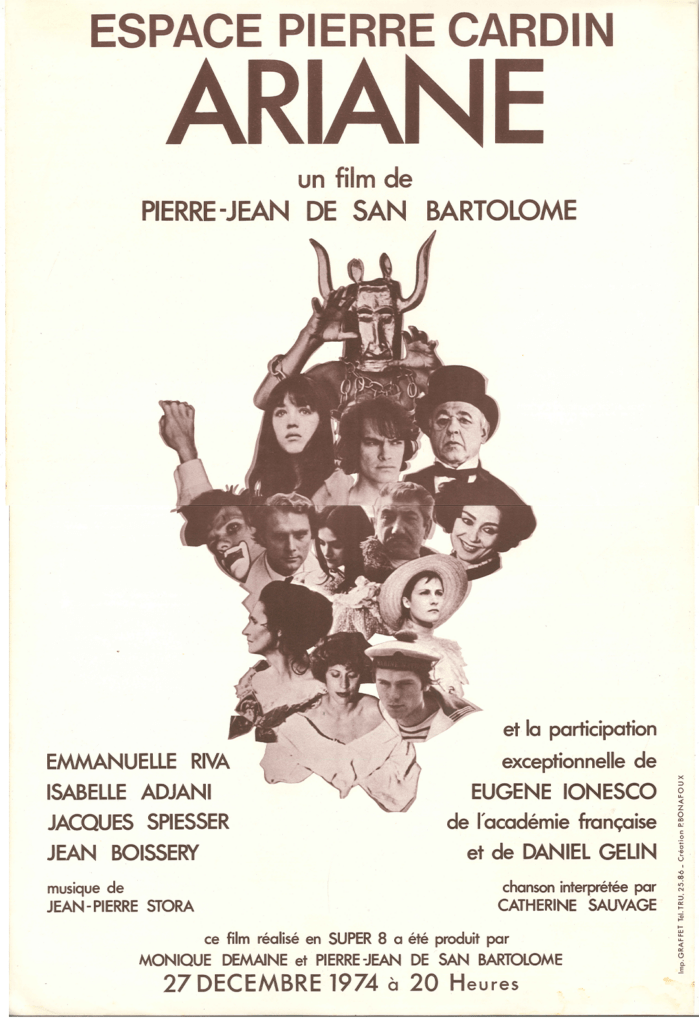
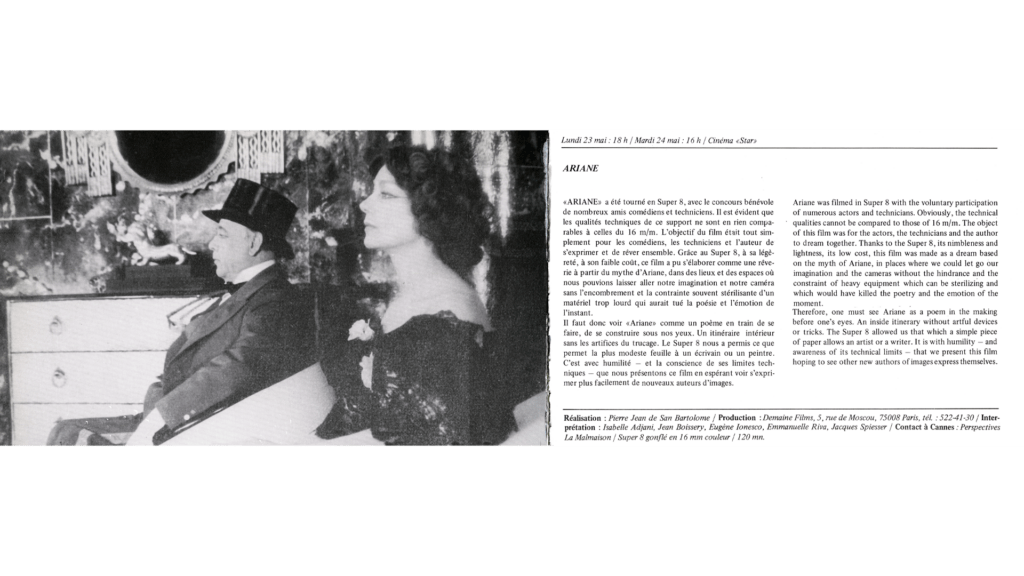
San Bartolomé shoots a feature film Ariane, an avant-garde film, created for three screens, with a handful of friends: Isabelle Adjani, Emmanuelle Riva, Jacques Spiesser, the Academician playwright Eugène Ionesco, Daniel Gélin, Jean Boissery…

Pascal Bonafoux designs the billboard poster, Jean Pierre Stora the film’s musical score. Editing is barely completed, when the simultaneous triple-screen projection must be abandoned due to the technical support never being finalised.

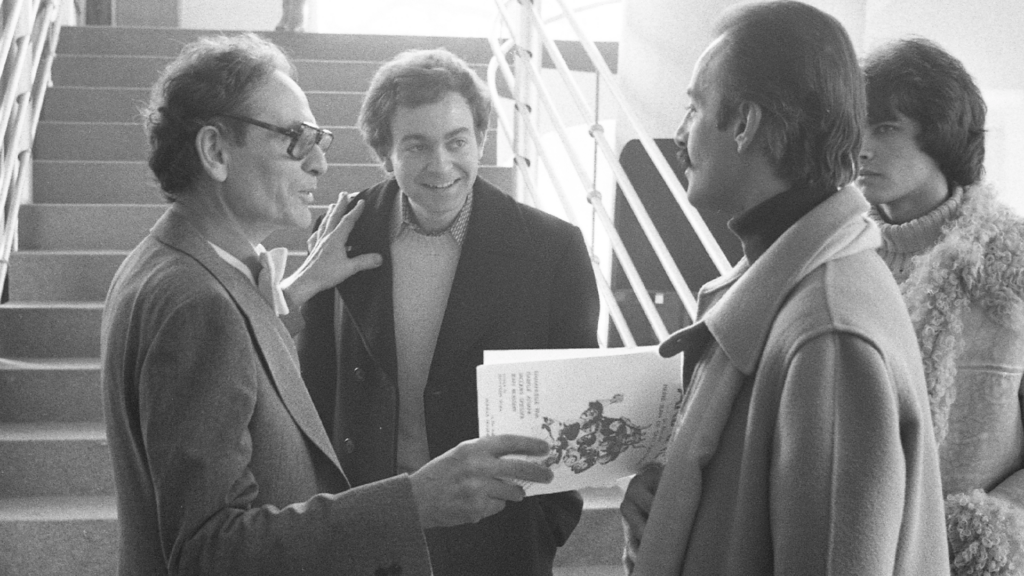
San Bartolomé has to re-edit the film for a unique screen. Despite many cuts, he finds it still too long. In his eyes it has lost a great part of its interest, given that the latter resided in the spectator’s freedom of choice between the three complementary but independent pictures. This offered several visions, actions and temporal spaces. Yet it is the sensation of the day at the First International Super 8 Festival at the Espace Pierre Cardin (December 1974).

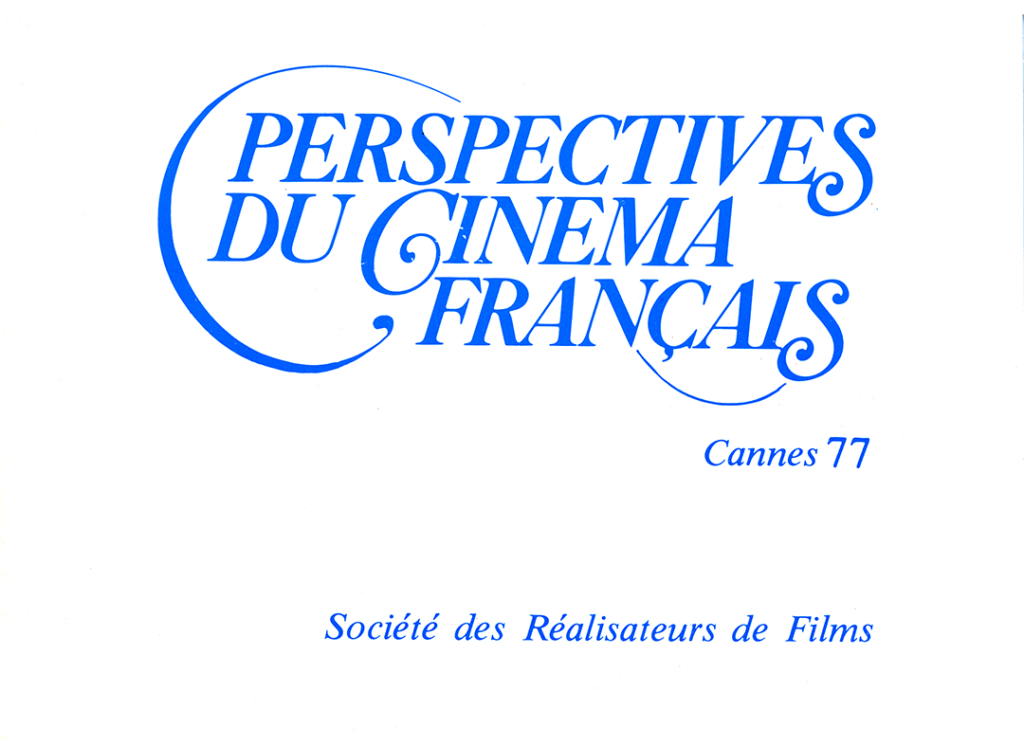
The film will then be shown, (in a version of 120mn, blown up into 16mm) at the 1977 Festival de Cannes in the Perspectives du Cinéma Français selection. 

Before being re-edited and recut by the film’s co-producer who wishes to exploit it under the absurd title «Espace Zéro» adorned, what is more, without the director’s permission, with grotesque cristal surimpressions supposed to indicate to the spectator the onirical passages. Whereas the film is onirical in its entirety!

With the help of Isabelle AdjaniJean Pierre Stora, and that of Maitre Pierre Hébey, succeeds in blocking the distribution and exploitation of a totally disfigured work. Of which only a few rushes remains in his possession today. 

The Super 8 support, not possessing any negative turns out to be very difficult to edit and unexploitable. It will quickly be abandoned in face of video pictures’ rapid progress…

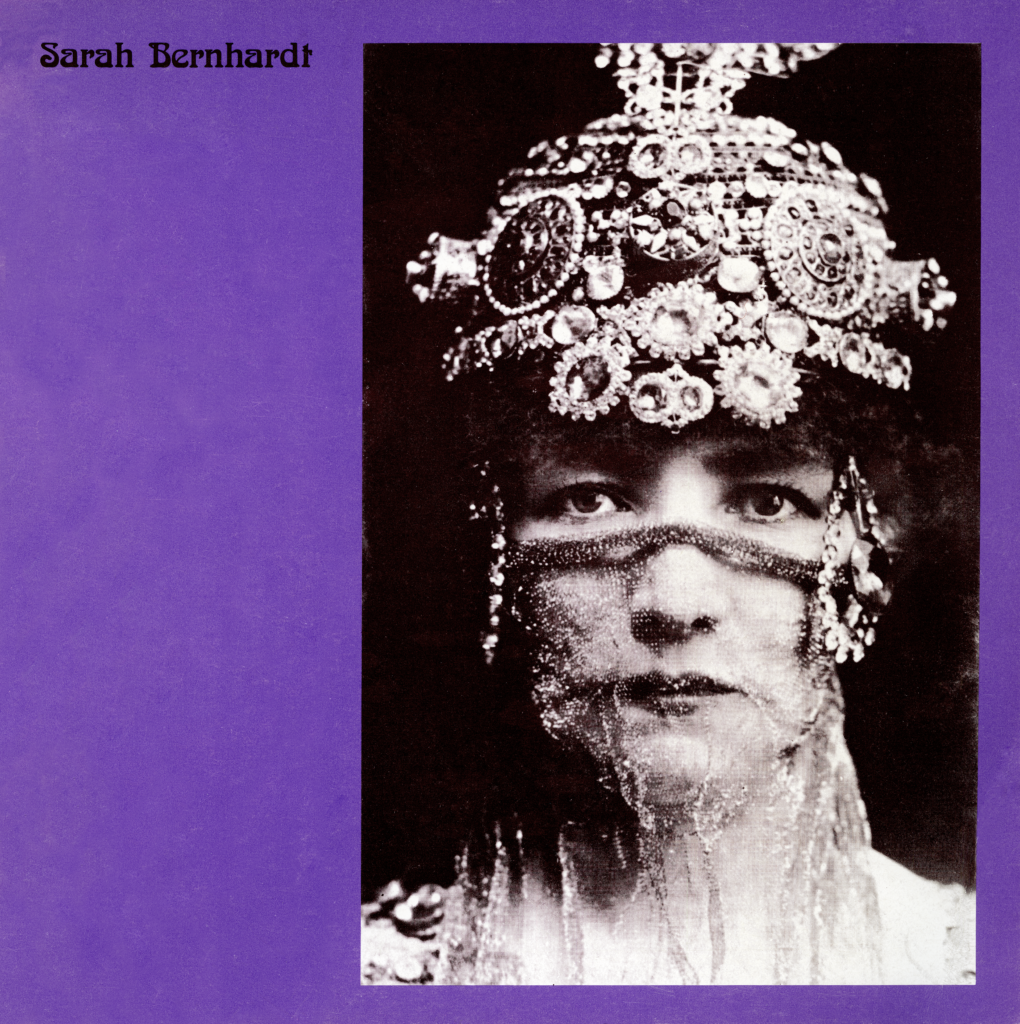
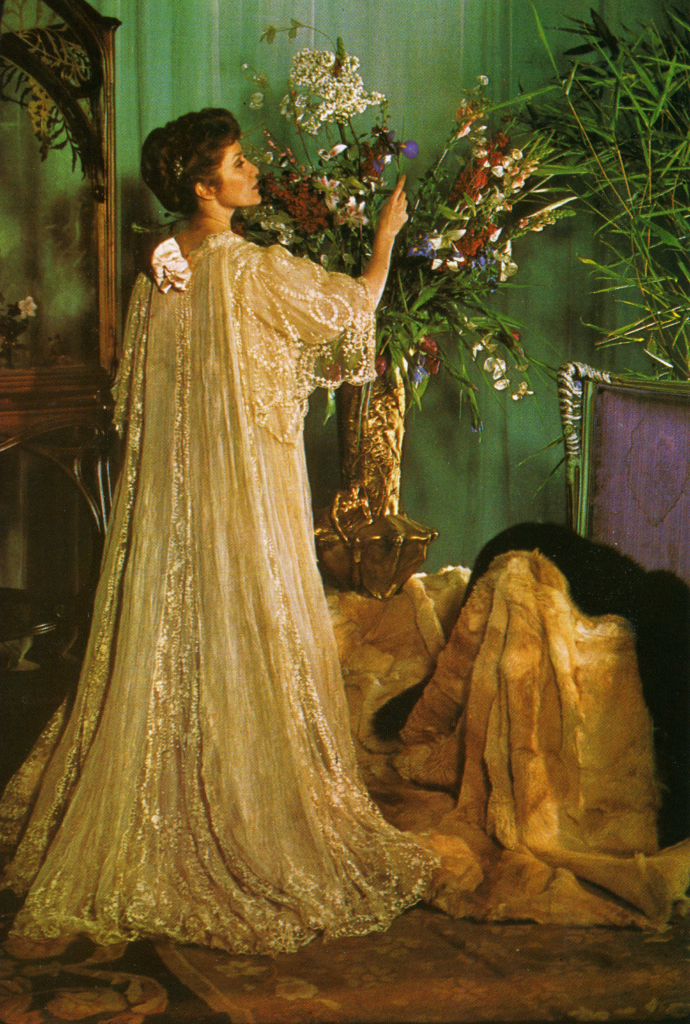
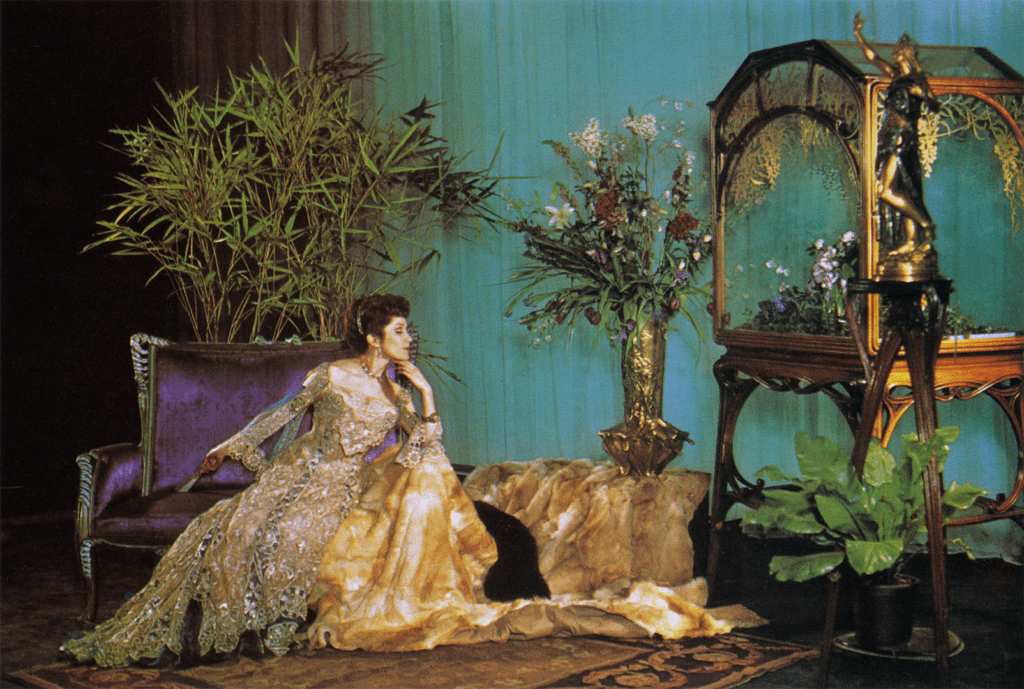
In 1975, Pierre Cardin presents the First big International exhibition devoted to Sarah Bernhardt, comprised of more than 700 objects, paintings, furniture elements, costumes, cars and some precious rare silent films loaned by Henry Langlois and the French Cinémathèque… disposed throughout the three levels of the Espace Cardin. San Bartolomé is its scenographer.

FROM SETTINGS TO WRITING, FROM THEATRE TO TELEVISION

For the Théâtre Firmin Gémier (Antony) and the Lucernaire Forum (Paris), San Bartolomé designs the costumes and settings for La Gioconda by Gabriele d’Annunzio, with Eléonore Hirt, as well as those of the Petit Maître corrigé by Marivaux, directed by Jean Rougerie (March and December 1977).

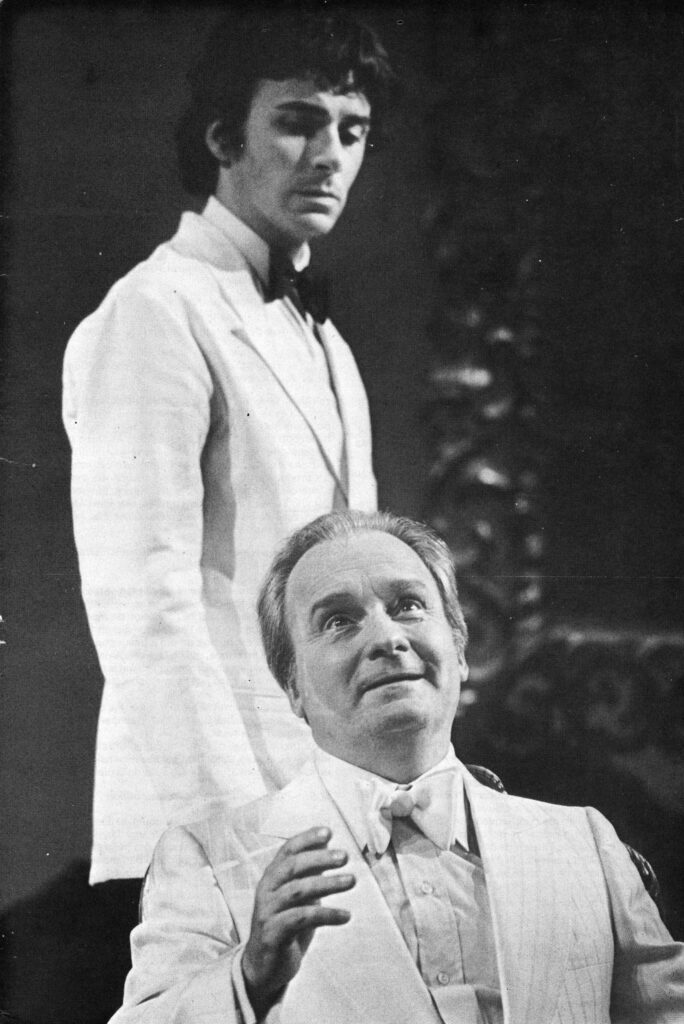
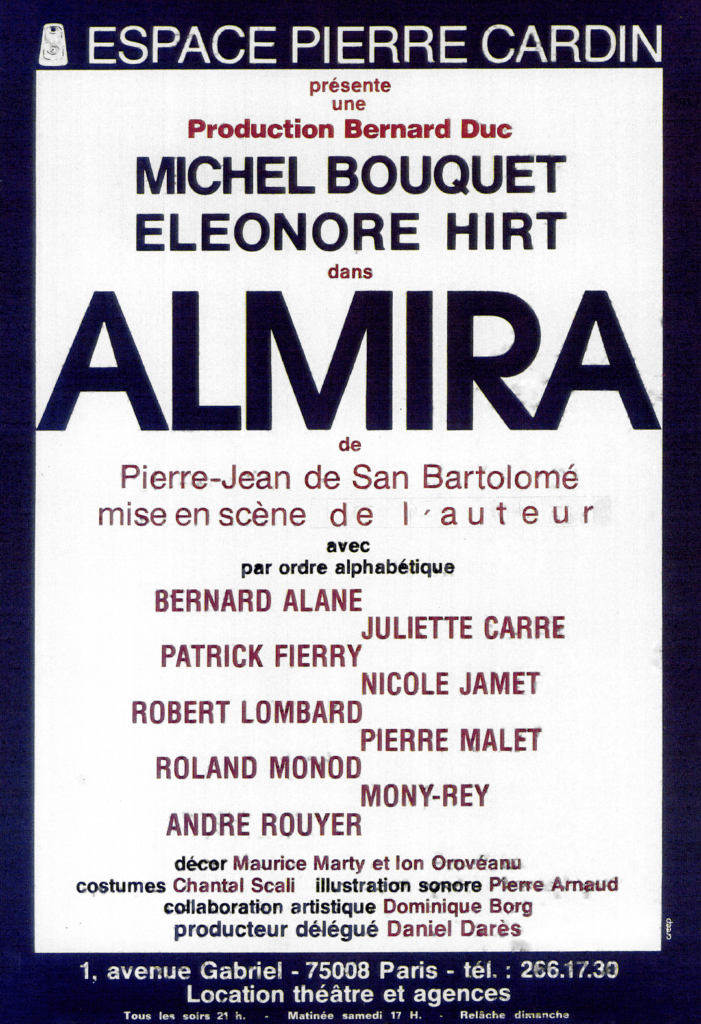
Michel Bouquet, creates his first play, Almira, at the Espace Pierre Cardin (Autumn 1978).

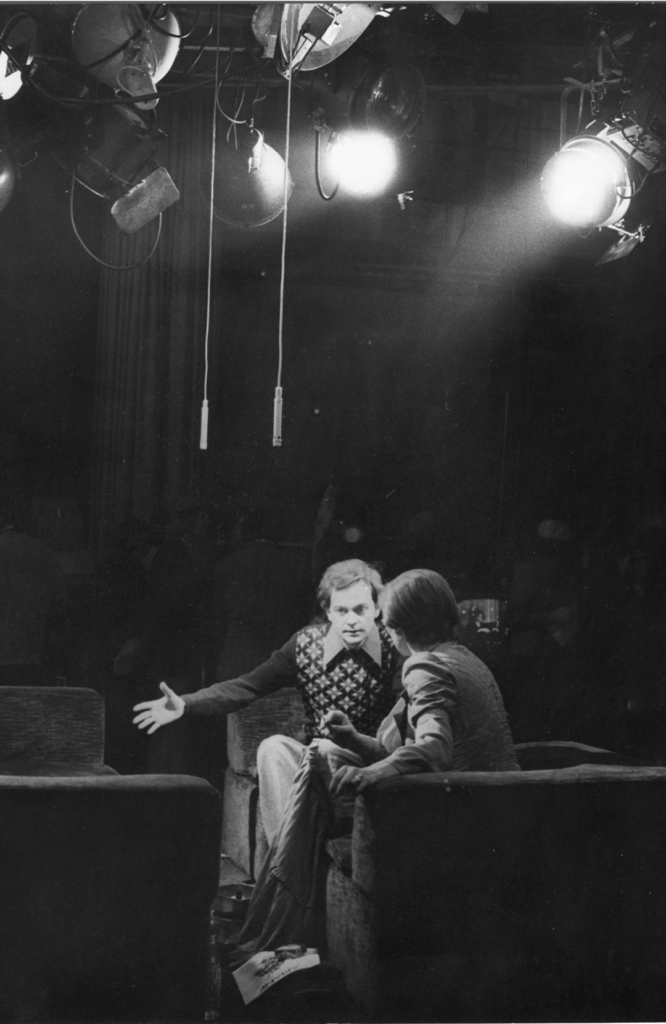
San Bartolomé now also works for television: he adapts Le voleur d’enfants by Jules Supervielle for François Leterrier (1979). Then co-writes with Jacques Laurent of the French Academy (Cécil Saint Laurent) the series Capitaine X for tv channel Antenne 2 (1980 à 1982).

He shoots a short film, Abandons (35mm), with Lambert WilsonNicole JametElizabeth BourgineEleonore HirtJean Pierre BouvierFranco Ressel and Vincent Poujol; co-produced by Philippe Dussart, co-presented with Les Favoris de la lune de la Lune by Otar Losseliani and then on television (1983).

In 1987, he shoots a feature film, Elizabeth, inspired from the murder of “Sissi”, the Empress of Austria, with Sophie DuezAnnabellaAndré DussolierJean SorelJacques LaurentVincent Poujol and Lilianne Rovere (1987).

FROM FESTIVAL PROGRAMMING TO OPERA DIRECTION

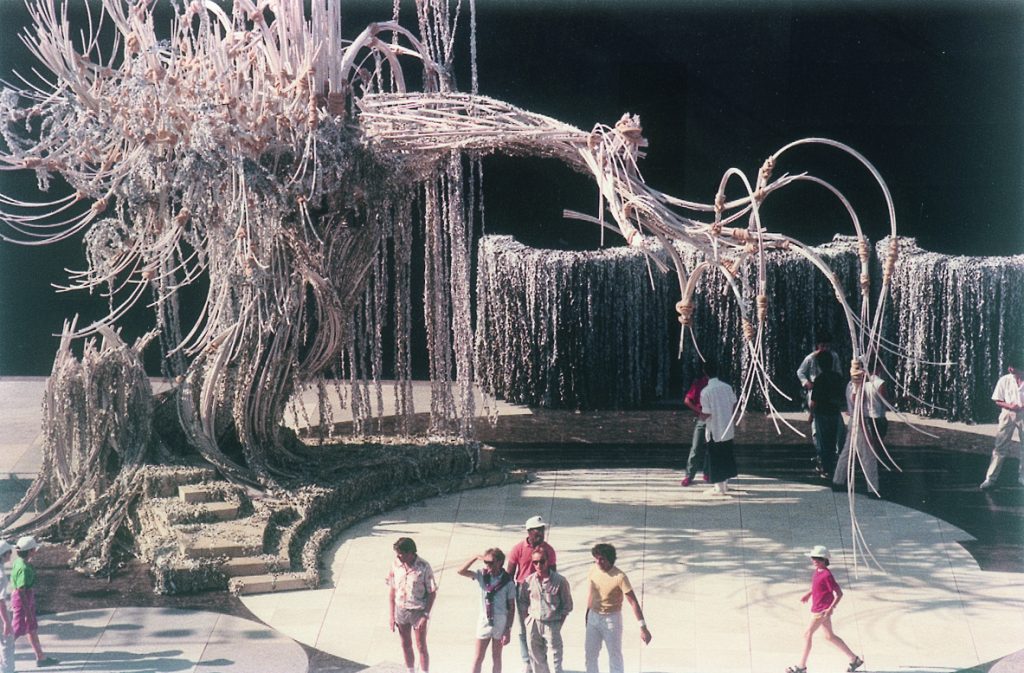
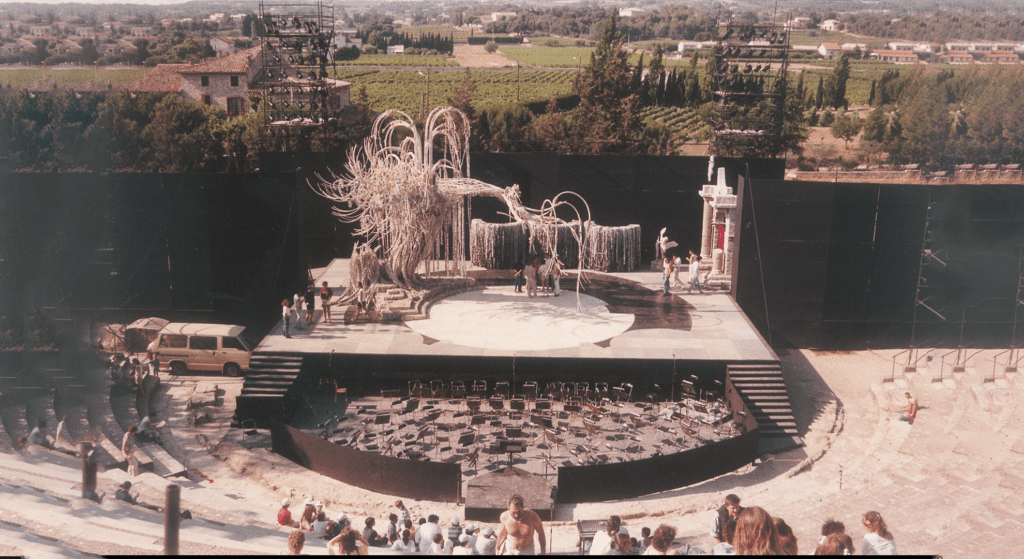
From 1980 to 1989, San Bartolomé is commissioned with the programming of the Festival de Vaison-la-Romaine, he creates a new space with 900 places in the midst of the archaeological excavations: the Théatre du Nymphée, there he directs Eurydice, opera by Caccini (1985) as well as A midsummer night ’s dream by Shakespeare and the complete musical score by Mendelssohn for the 4500 places of the Antique Theatre (1986).

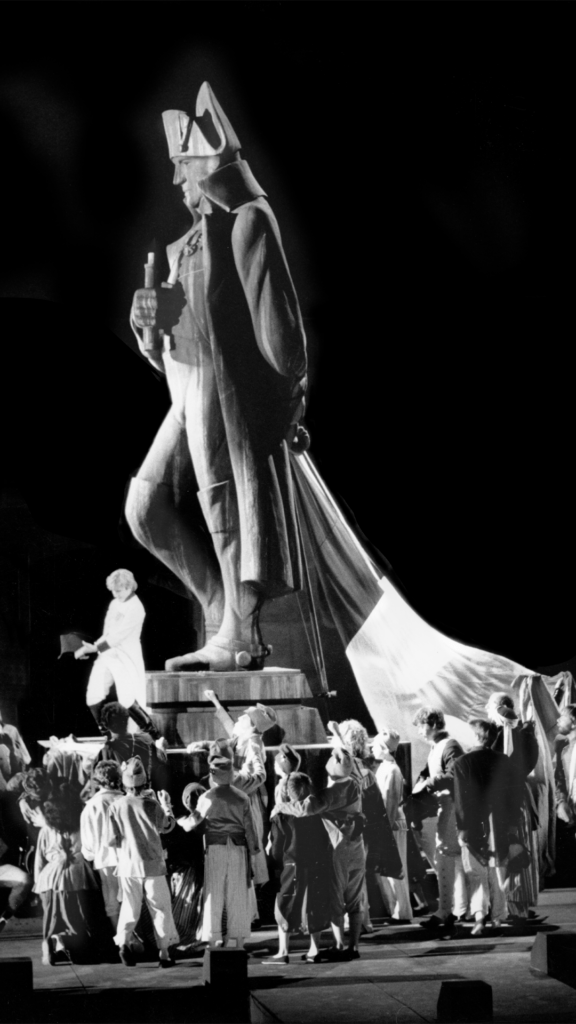
He then directs Arthur Honegger and Jacques Ibert’s L’Aiglon, with the Radio France’s New Philarmonic Orchestra (NOP), recorded by France 2 Television (1987).

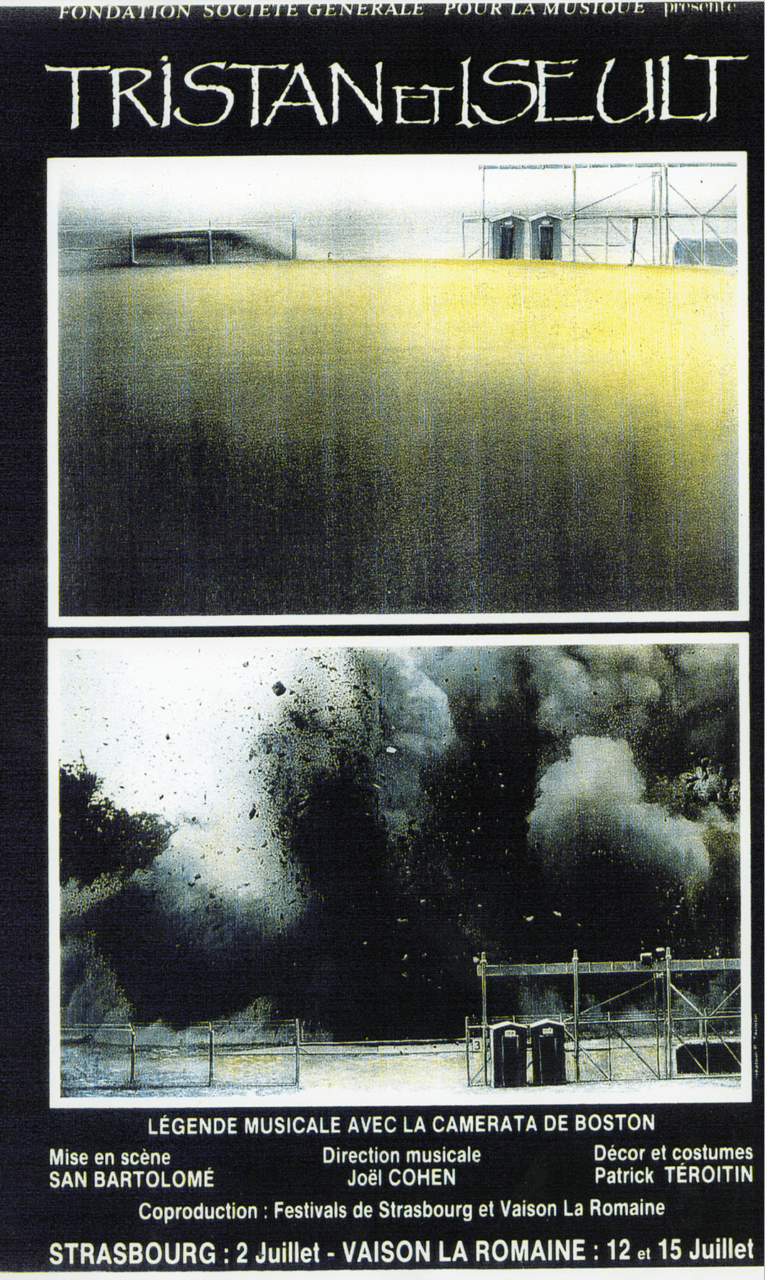
With the Boston Camerata, San Bartolomé signs the production of Tristan and Iseult which takes him from New – York to Boston and which closes the 50th Strasbourg Music Festival before being presented at the Festival of Vaison (Feb to June 1988).

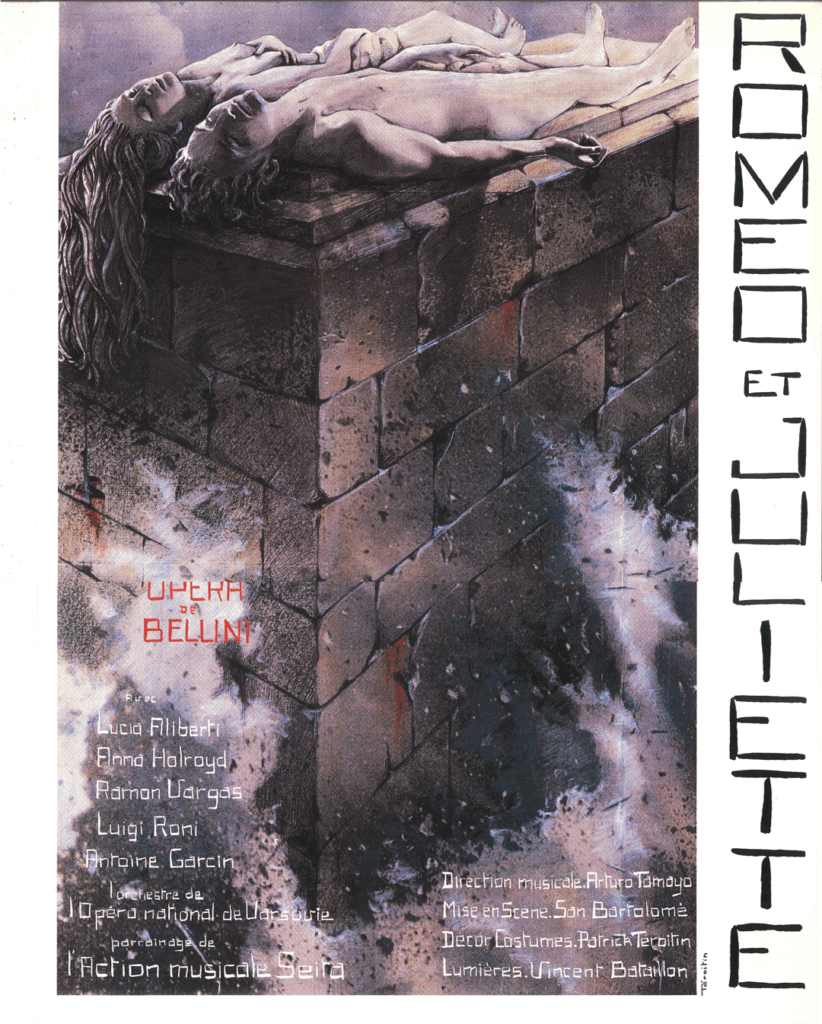
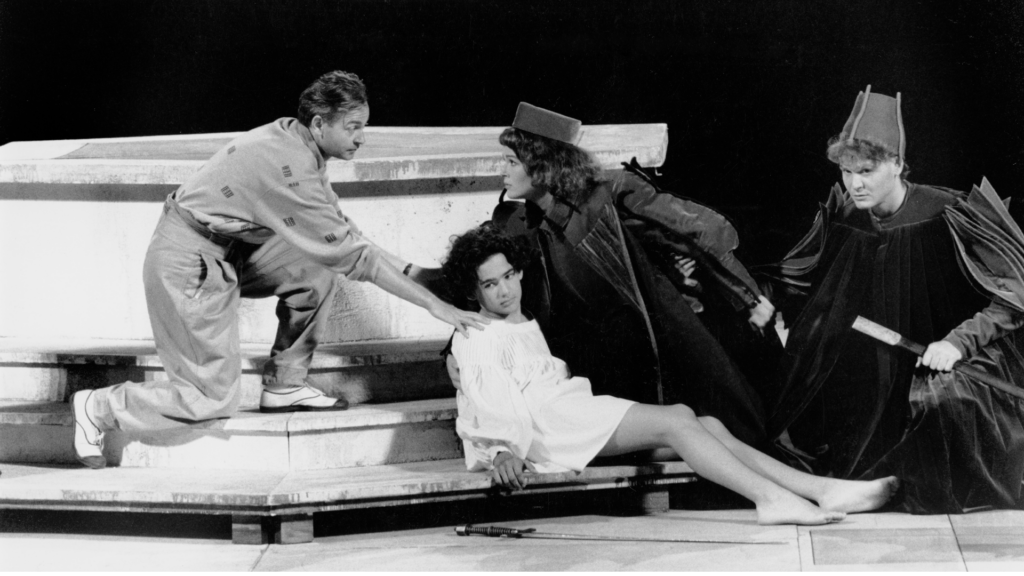
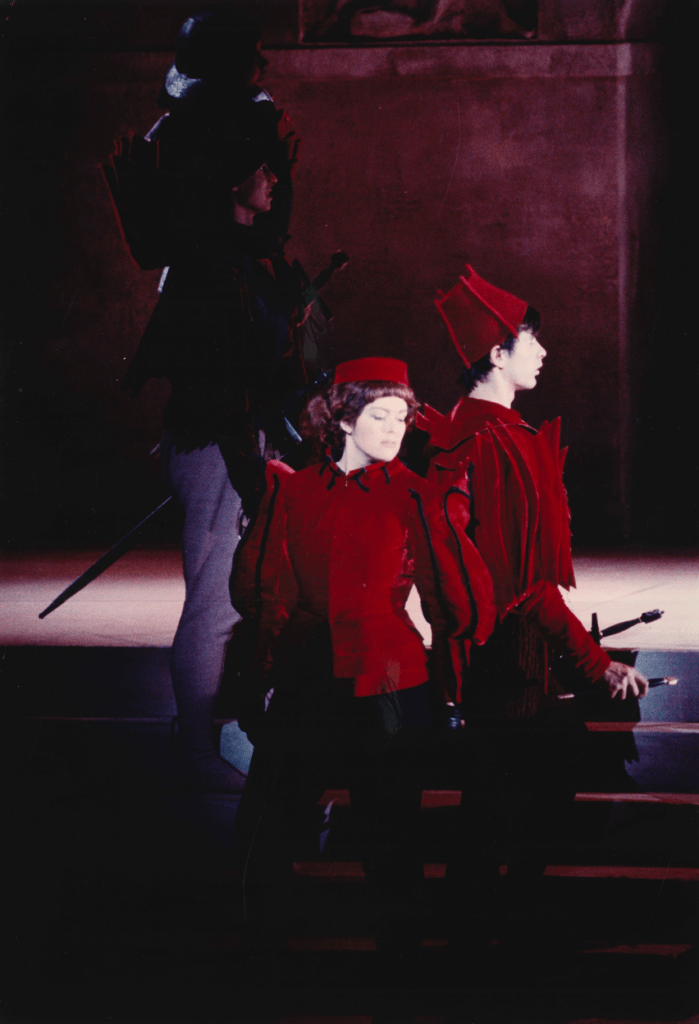
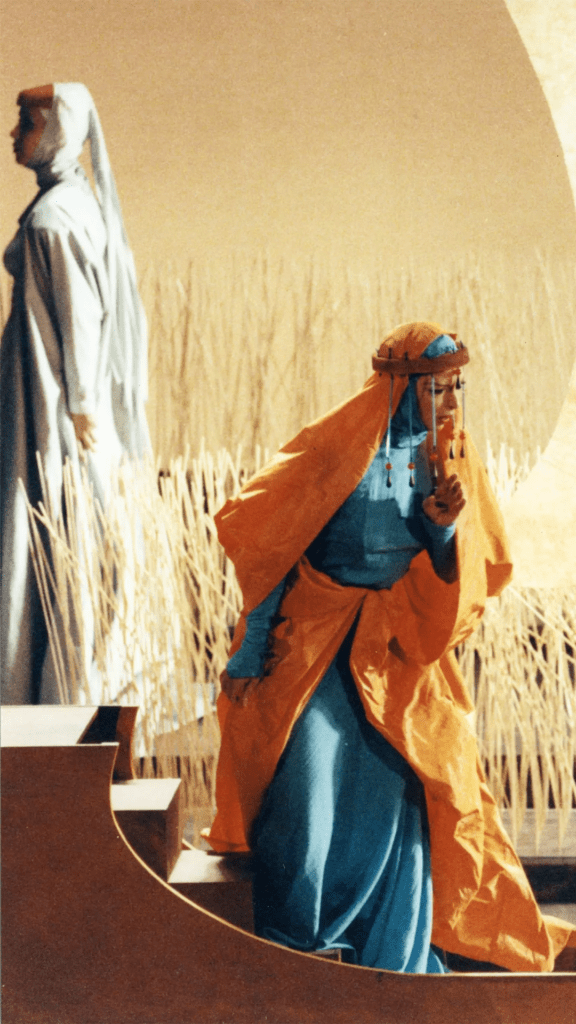
San Bartolomé’s direction of the I Capuletti e i Montecchi Opera (Vincenzo Bellini‘s Romeo and Juliet) at the Festival of Vaison-la-Romaine (1989), is a complete rediscovery for the public; presented at the Vichy Opera, at the Festival Méditerranéen as well as at Théâtre des Champs Elysées, in Paris (December 1990).

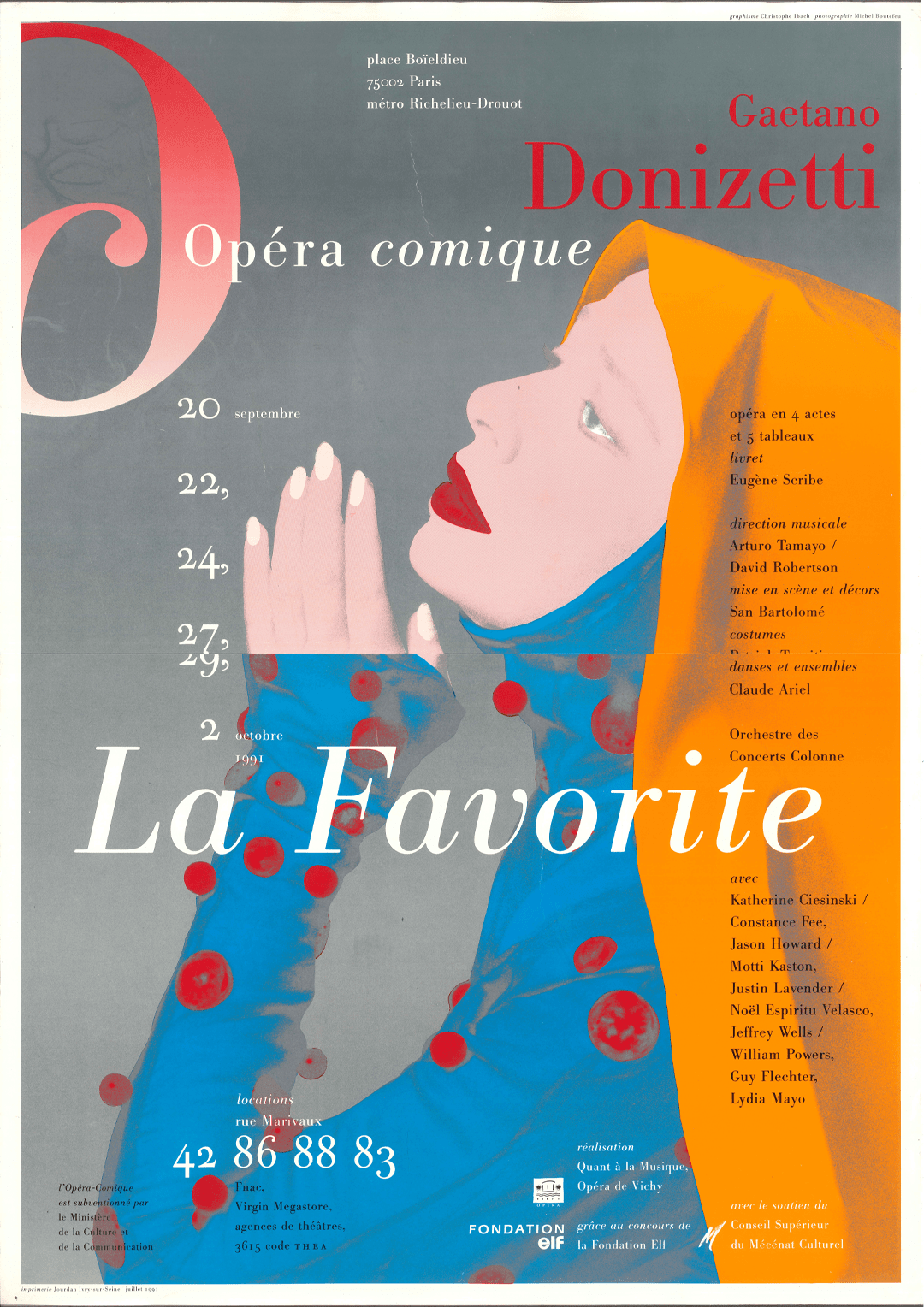
His new direction of the Opera La favorite by Gaetano Donizetti presents the rarely performed original French version, completed with an as yet unperformed tune. (Opéra Comique and Théâtre des Champs Elysées – Paris, 1991) then at the Jiry Kylian National Dance Theatre (The Hague, 1992).

A YEARNING FOR ASIA

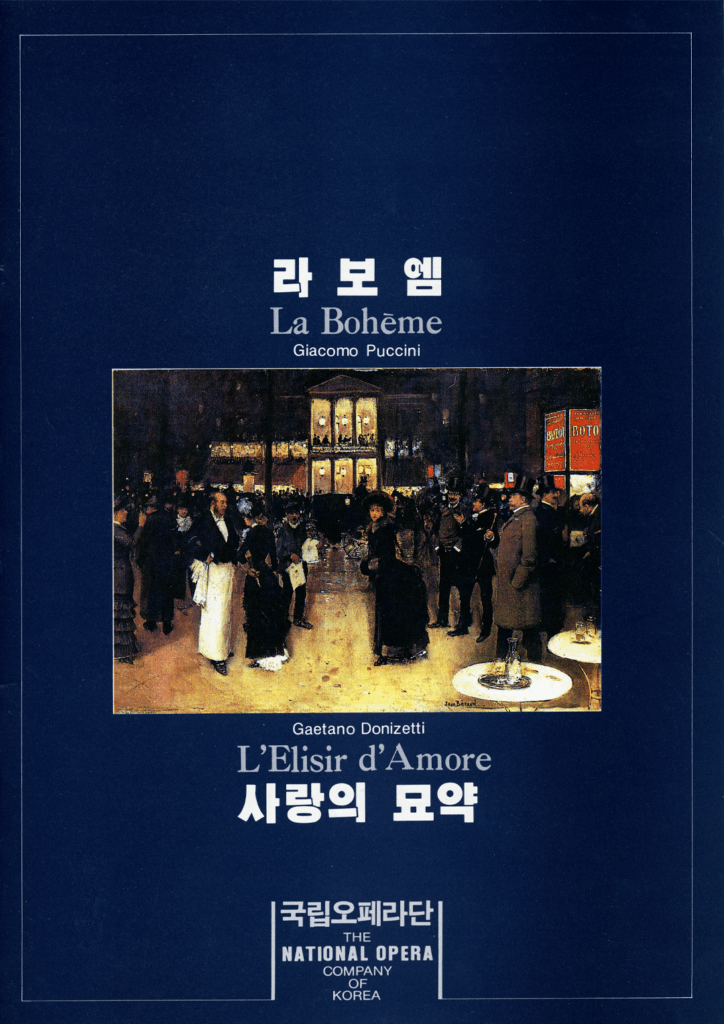
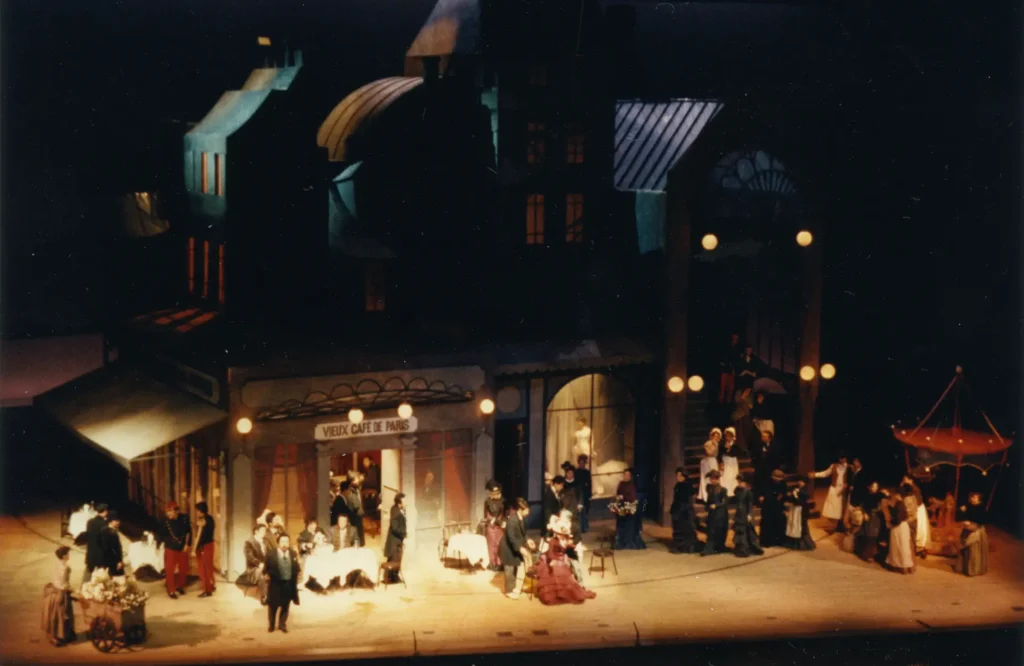
San Bartolomé is invited to Seoul by the Korean National Theatre where he directs La Bohème by Giacomo Puccini, also designing its settings and costumes (1990) – which brings him to discover a fascinating culture and confirms an authentic «Yearning for Asia», which was already present in his childhood. This marks the beginning of a long series of trips, and cultural exchanges with Asia spanning a period of 25 years.

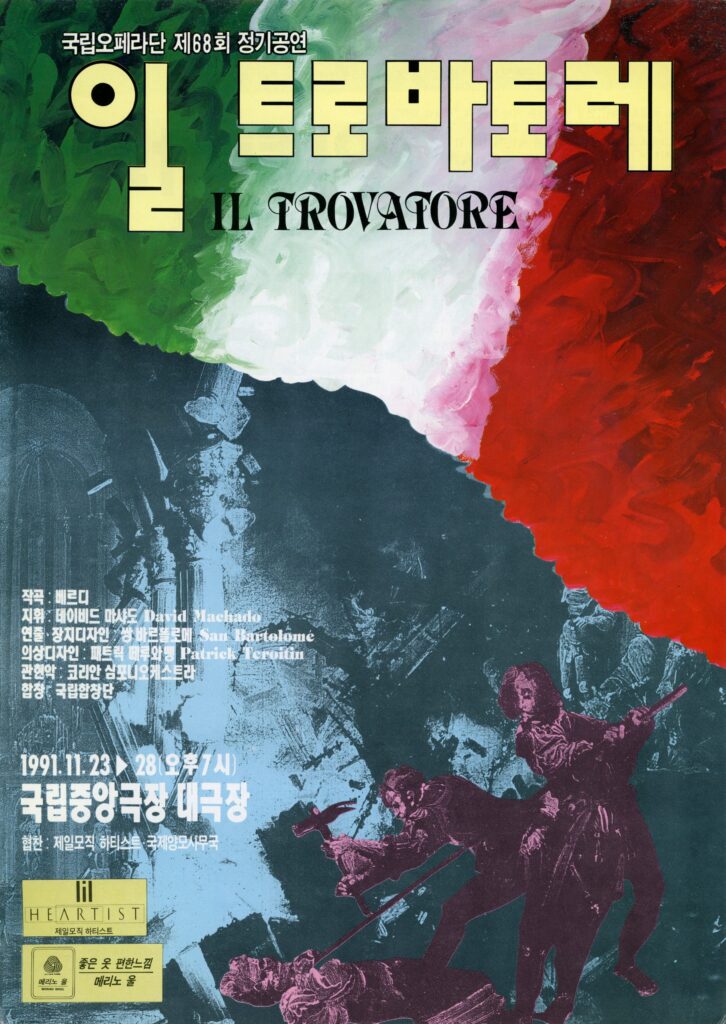
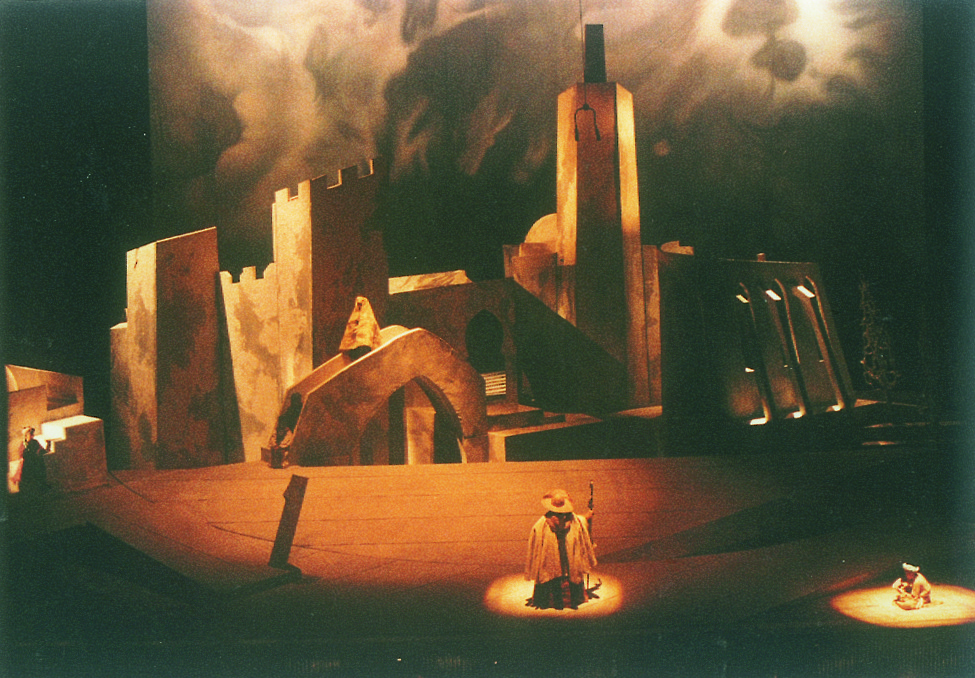
Following the success of his direction of Donizetti’s Elixir d’Amore, he is reinvited by the National Opera Company for Giuseppe Verdi’s Il Trovatore (1991).

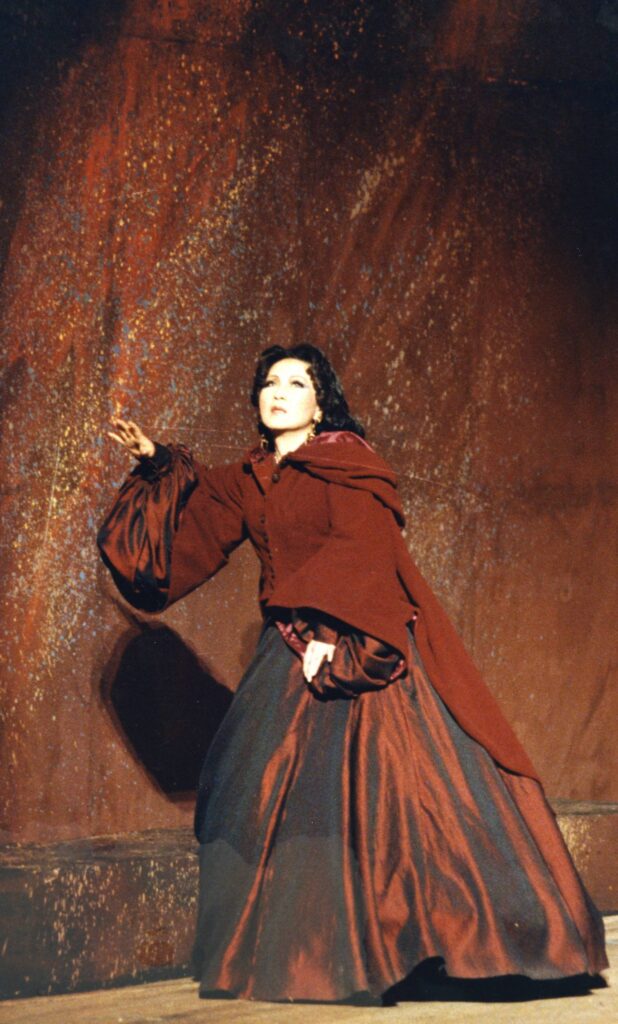
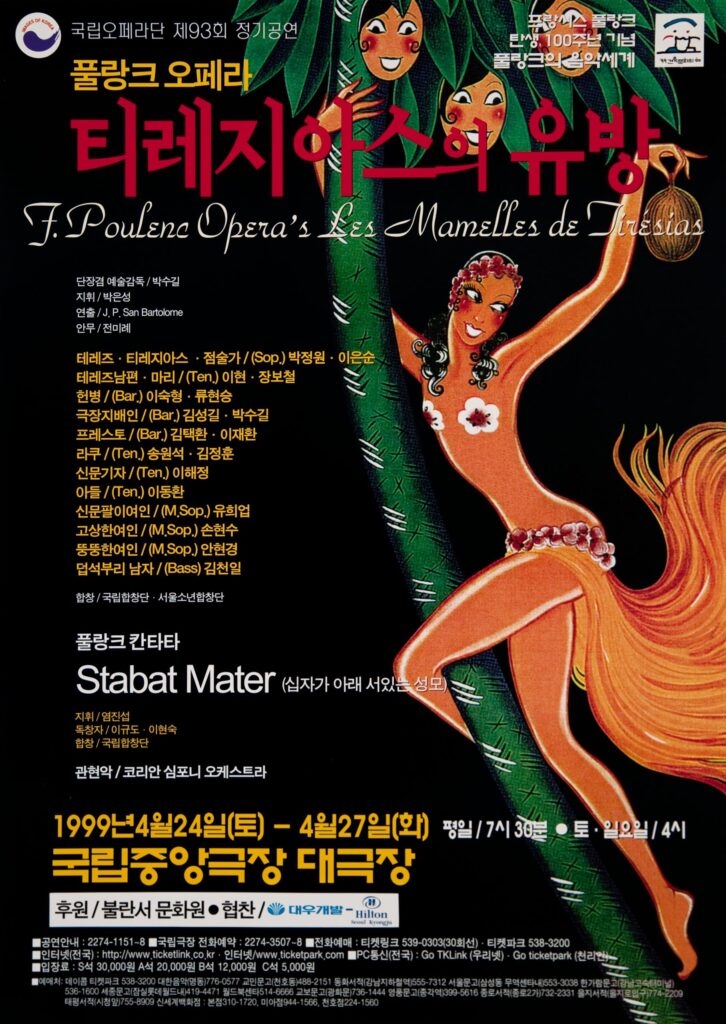
He is then invited to stage La Favorita (1992) for its creation in South Korea, Carmen (1993), Manon Lescaut (1996) and he creates Francis Poulenc’s Les Mamelles de Tirésias (2000).

From Korea there is only one step to discover or re-discover in situ the cultures of China, Vietnam, Japan, Cambodia, Malaysia, the Philippines, Indonesia…

Festival Asie-Occident

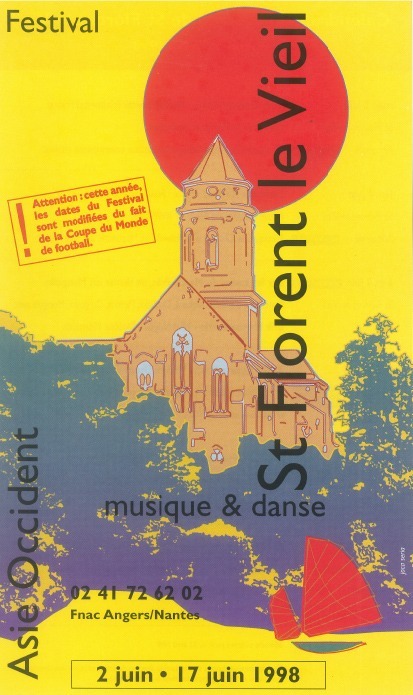
Based on his discoveries, San Bartolomé decides to propose to the French Ministry of Foreign Affairs, Hervé de Charrette, an Asia-Occident Festival. The idea is, for the first time in the history of festivals, one of authentic, unique exchanges and creations between artists, composers, choreographers, authors, actors, public and private institutions, show organisers… mingling the cultures of the two continents. The cultural events take place at St-Florent-le-Vieil, at the Palais des Congrès and the Maison de la Culture of Nantes and at the Angers Opera. Some are exported to France and Asia.

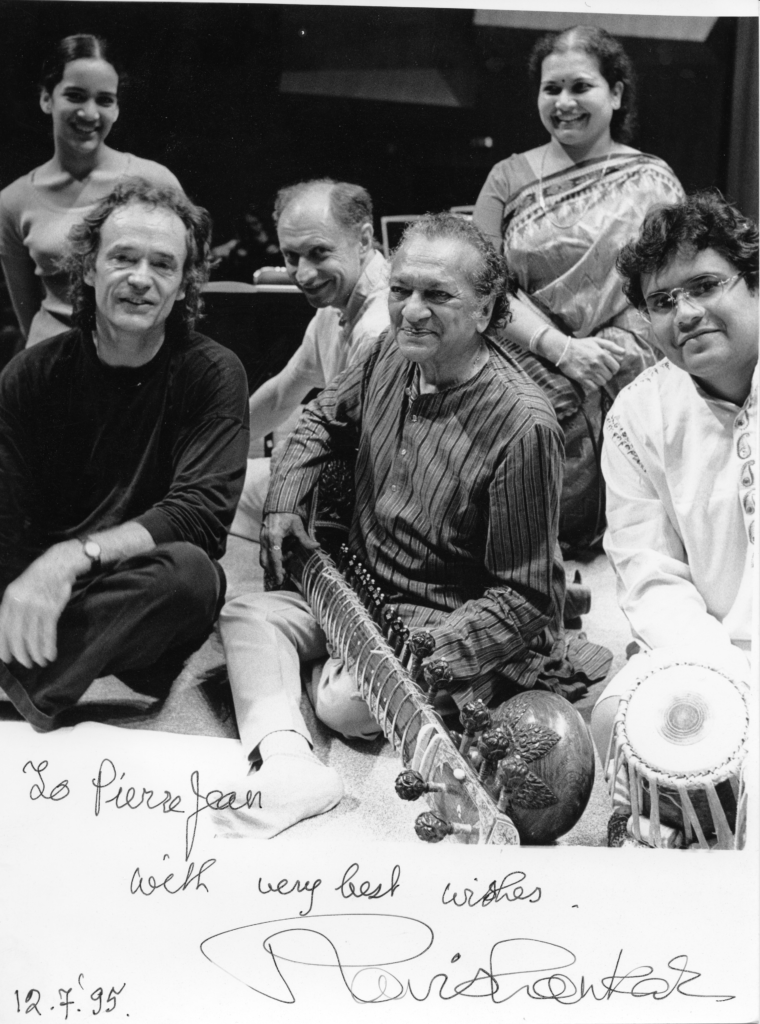
During ten years the most famous artists and artistic formations meet there, amongst which: Ravi Shankar for the creation in France of his First Symphony for Sitar interpreted by Lille National Orchestra led by Jean Claude CasadesusMaurice Béjart for the creation in France of Shéerazade with the Ballet of Berlin; the National Radio France Orchestra led by Ken NaganoJordi Savall and Masako Hirao for St Francois Xavier, a Journey from Portugal to Japon;

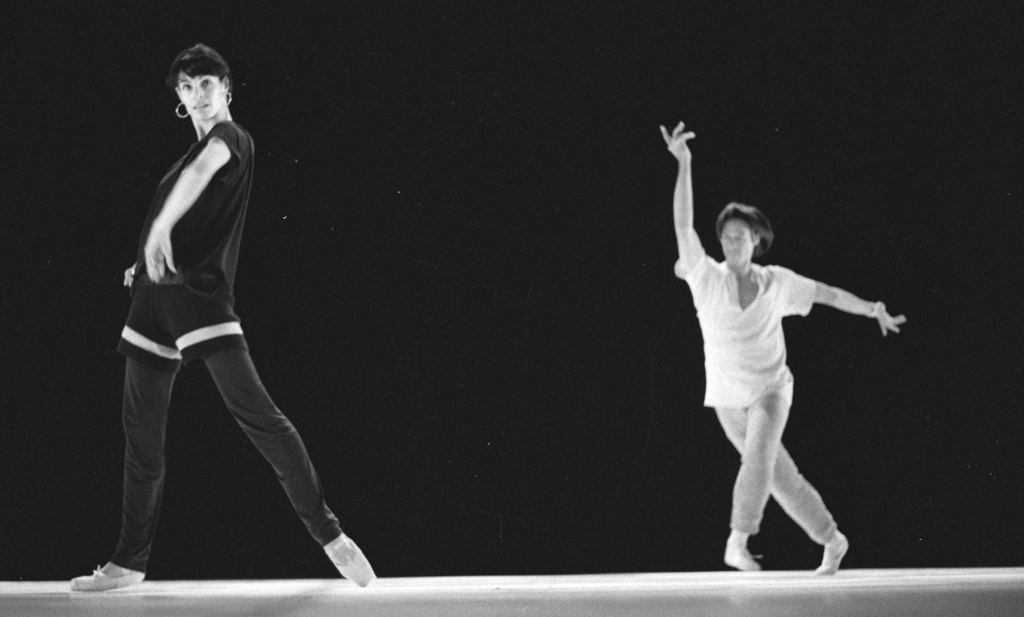
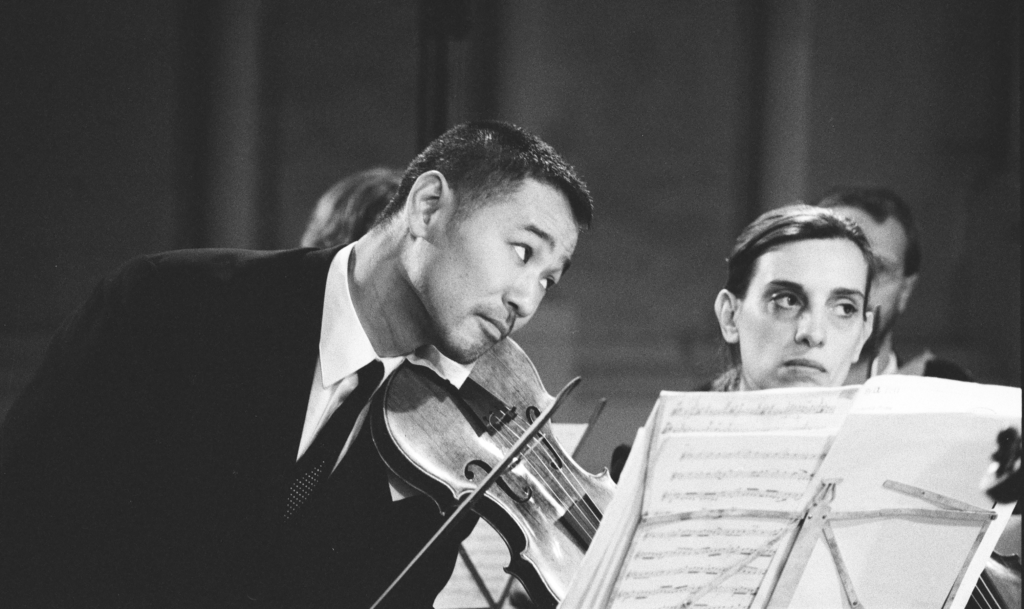
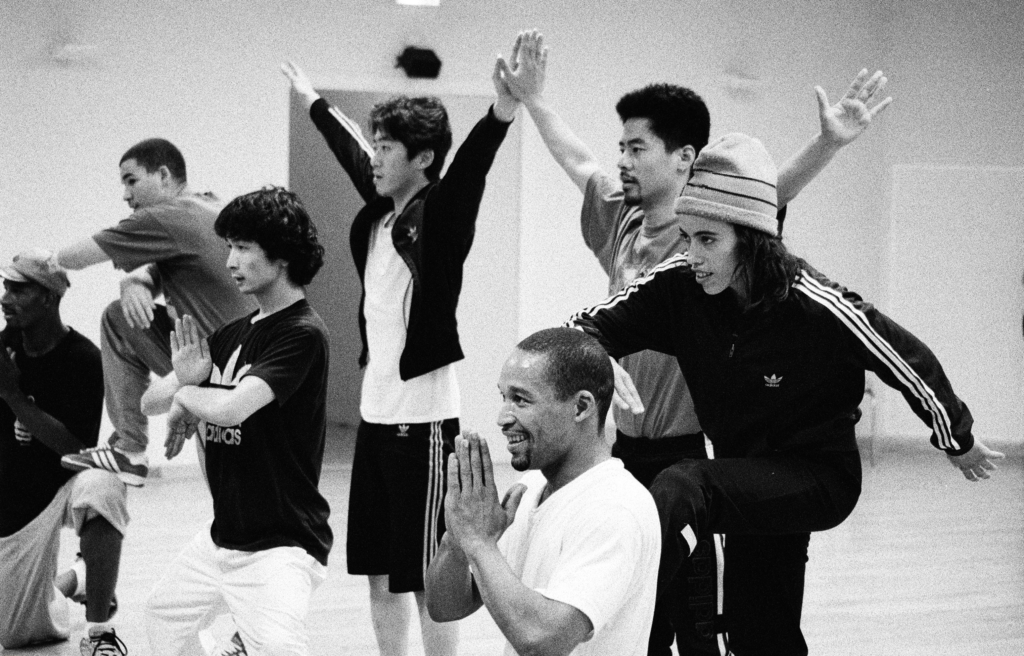
Susan Buirge with the Ma To Ma Company create De l’autre coté du vent doré co-produced by the Avignon Festival (1994) then La terrasse à l’ombre de la lune , a world creation (1995); the Tokyo Ballet with Marie-Claude Pietragalla in a Jiry Kilian creation; Jeff Buckley – whose last concert of his ultimate European tour it will be – meeting Alim Qazimov , Azerbadjian’s most famous vocalist, during a fabulous evening ending with a jam session which will remain in the memories. (1995); the Indian dancer Shantala Shivalingappa, Vempati Ravi ShankarMontserrat Figueras and Jordi Savall giving to life Pondichery, une évocation chorégraphique et musicale; the Aktuel Force Hip Pop group with The Ravers, a the Japanese group, creating a Break Dance show (1997); Hiro Kurosaki conducting Les Arts Florissants at an evening devoted to the JS Bach’s sons and Karine Saporta creating Nouvelles de Chine with the Canton Contemporary Dance Company (1998); Zhang Ya Dong performs at the side of the famous chinese rocker Do Wei, whose first appearance it is in Europe; the Miao polyphonics meet with the Corsican national polyphonic ensemble A Filetta (Corsica)…

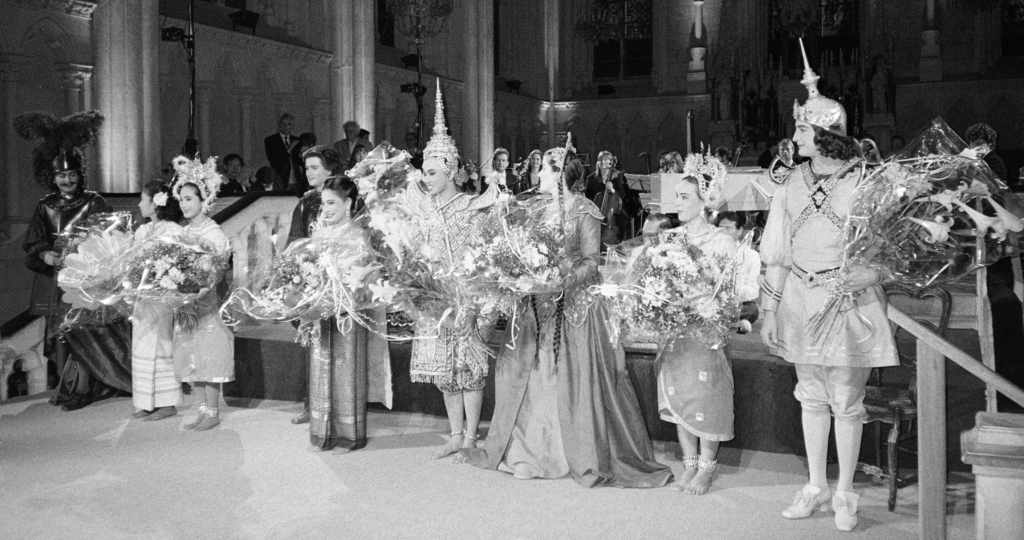
From 1989 to 1998, San Bartolomé acts as stage director of many original creations: Louis XIV and Siam with the Royal Theatre of Thaïlande, the Concerto Köln, with some excerpts from Jean Baptiste Lully’s opéra Roland, a Theatre des Champs Elyséees production (1994)…

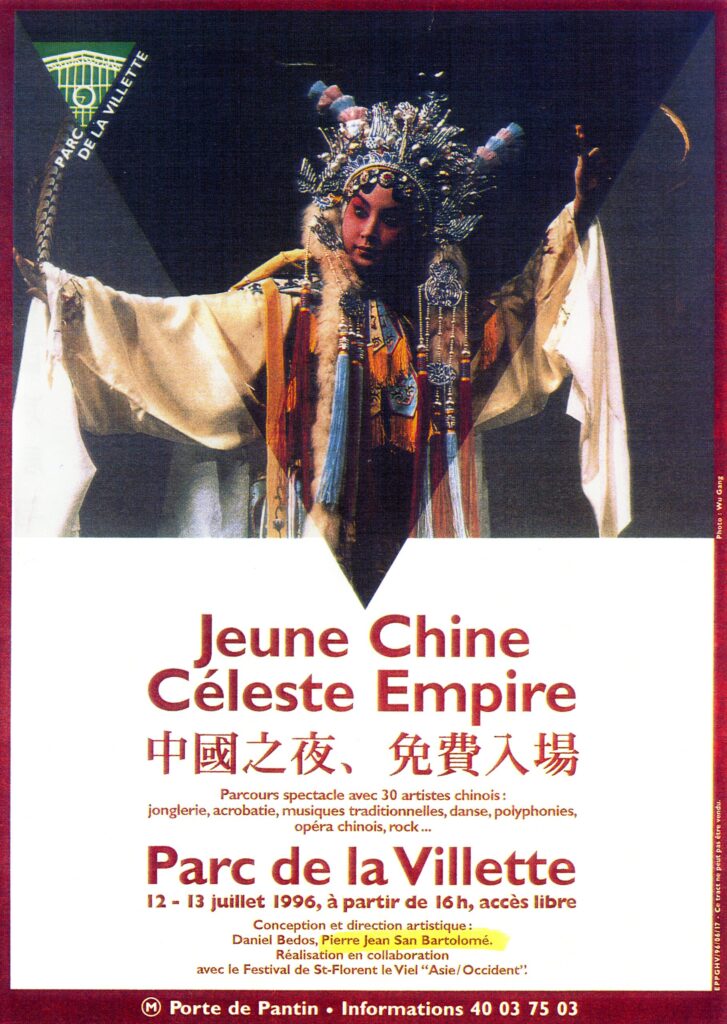
Jeune Chine, Céleste Empire (1996), in collaboration with the Printemps des Comédiens as well as the Parc de la Villette.

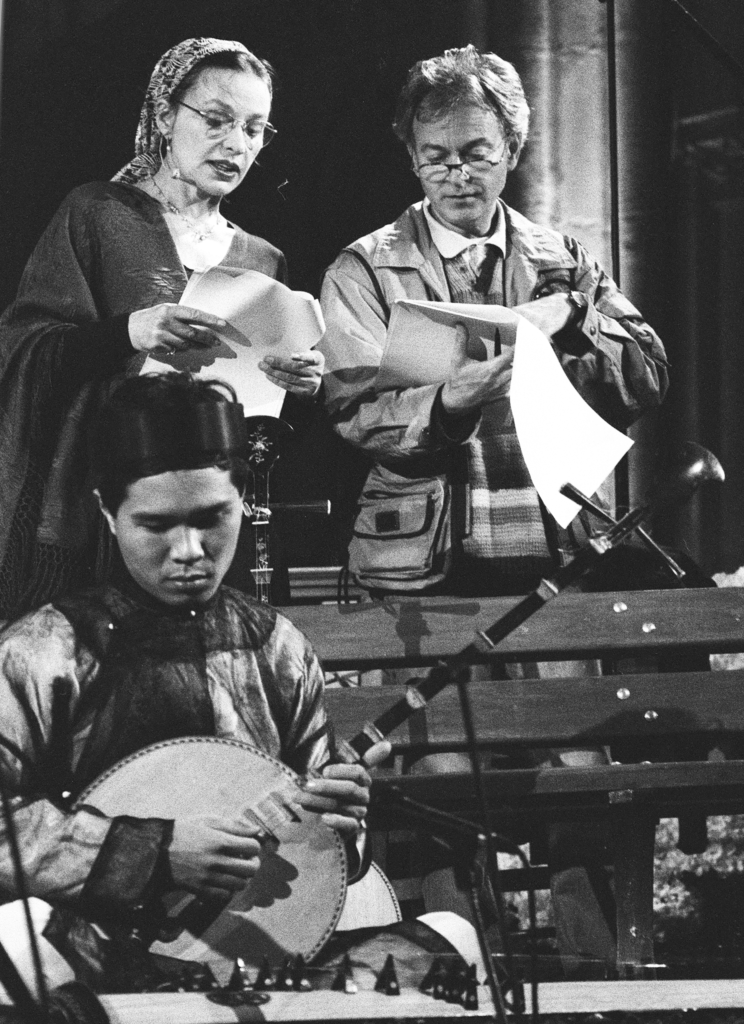
Victor Ségalen, A poetic and musical journey with Jean Claude Carrière and Contes du Vietnam by Nguyen Lê with Didier LockwoodPaolo Fresu and the choreographer Thierry Thieu Nang (co-production with the International Jazz Festival Banlieue Bleue, 1996); Mékong, mémoire d’un Fleuve, le Vietnam by Marguerite Duras, with Marie Laforêt and the musical formation Ca Tru from Hanoî; And so on…

In 1996, in Hong Kong, San Bartolomé is the lightings manager for Daniel Bedos’s La route tzigane.

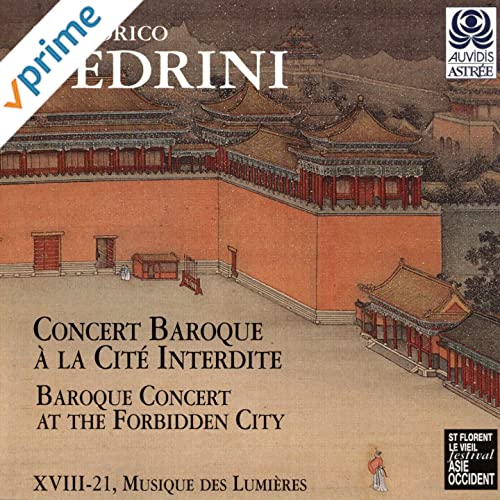
In 1997, he organises a concert based on Téodorico Pédrini’s sonatas: Un jésuite à la cour des empereurs de Chine, performed at the Palace of prince Gong near the Forbidden Imperial City in Peking; Pedrini, a jesuit priest, was music master and preceptor of the Chinese imperial children (cd by Auvidis/Astrée). Also presenting Opera Buffa meets Chinese Opera at the Théâtre Hai Dian in Peking.

In 2000, a major project for a musical comedy inspired by Le tour du monde en 80 jours, by Jules Verne, music by Singaporian Dick Lee, llibretto by San Bartolomé, a co-production between the cities of Shanghai, Singapore and Seoul : sadly, didn’t materialise in the end.

PHOTOGRAPHY: MEETING THE ‘OTHER’

Being used to sharing the cameras and filming material of a father having a passion for pictures, as far as he can remember San Bartolomé sees himself cameras in hand, busy taking pictures or filming his friends, and the artists met.
He has realised a large amount of photographic reports throughout his voyages. Yet he had to wait till the revelation of his Asian discoveries for him to decide to exhibit his photographic work.”

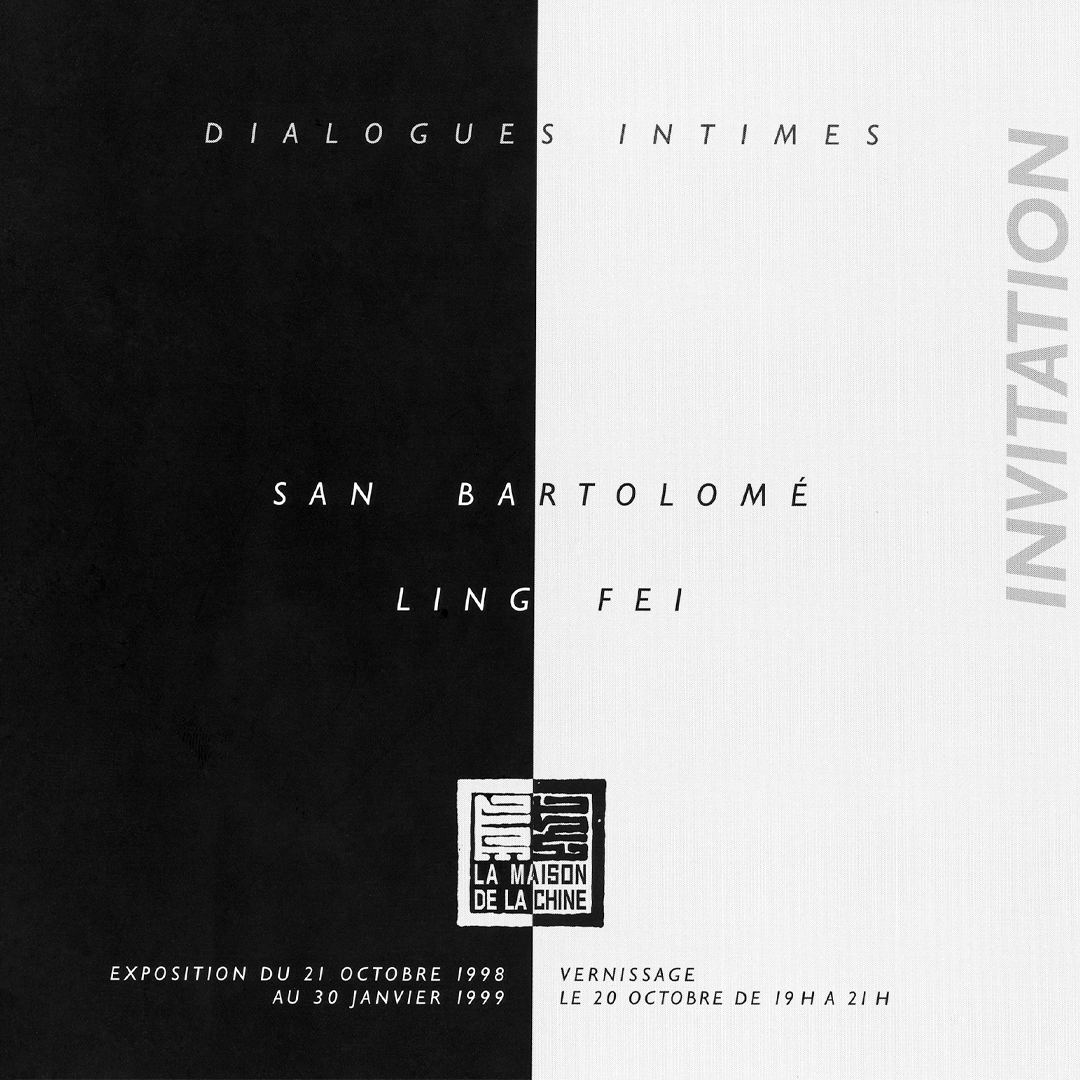
In 1998 San Bartolomé’s first photographic exhibition Dialogue intime, with photographer Li Fang, takes place, at the Maison de la Chine, Paris. It is the fruit of his initial travels and sojourns in Asia. The book Au bois dormant / Sleeping Beauties comes out at the same moment. The Alliance Française of Singapore gallery exposes his Indonesian work Parantritis, sunday on the beach (Jan- Feb 1999). Sleeping Beauties is invited to the Aarhus Festival in Danemark as part of Pictures from the dragon’s garden exhibition ( Gallery Image ) (Septembre 2000).

FRANCE-CHINA CROSS-CULTURAL YEARS : CULMINATION OF THE VOYAGE

In 2002, given his familiarity with the provincial cultures. Of China, San Bartolomé is comissionned by the French Ministry of Foreign Affairs in relation with the Années Croisées France-Chine, (France- China Cross-cultural Years), a major cultural and political event willed by Presidents Jacques Chirac and Hu Jintao

(nearly 300 events in each of the countries). Jean Pierre Angrémy and Olivier Poivre d’Arvor place San Bartolomé In charge of the selection of the traditional arts of the Chinese show to be presented in many different French cities.

He then returns to the Chinese provinces which he has criss-crossed at length along his many travels during many years already with his friends of the Chinese People’s Friendship with Foreigners Association;
He invites, amongst others, Le miroir aux lychees, an extremely rarely seen opera

Li Yuan Xi and the most renown formations of Nan Yin or Nan Kuan to perform at the Théâtre de la Ville in Paris (2004).
In the autumn of 2003, he is nominated at the French Embassy in Peking as Artistic cultural Attaché, as an intermediary between the French and Chinese commissions for the management of the artistic events of the Année de la France in China.

San Bartolomé continues his work as a photographer : Fan Dian, director of the Beijing Central Academy of Fine Arts,(CAFA) invites him to participates to the Encounters exhibition (December 2003). Major specialist of Contemporary Art, Fan Dian will become the director of Meishuguan, the Chinese National Museum of Fine Arts.

The galerist Chen Xing Dong presents San Bartolomé’s work at the First Salon d’Automne de Pékin at the National Museum, Place Tian An Men (2004).

In 2005, under the title, Croisements/ Crossroads, San Bartolomé realises several series of studio photos, – one with Pierre Cardin and his Chinese close collaborators – at the Central Academy of Fine Arts of China Studios.

In the autumn of 2005, his personal photography exhibition Digital – participating to the closing events of the Year of France in China – is inaugurated by the French minister of Culture Renaud Donnedieu de Vabres at the Chinese National Museum of Fine Arts (Meishuaguan). The book that was made from the exhibition’s catalogue under the title Ombres Chinoises (2006) and prefaced by Isabelle Adjani, comes out in France during the Salon du Livre.

THE CROSSROADS FESTIVAL : EXEMPLARY CULTURAL EXCHANG

In 2006, with the support of ambassadors Philippe Guelluy, suivi de Hervé Ladsous, San Bartolomé creates Croisements (Crossroads) / Jiao Liu. With the help of both the french and Chinese Ministries of Culture, as well as of the consulates, and thanks to his passion for exchanges he imagines the programming of the three first editions until the end of the Peking Olympic Games (August 2008);

organising very high-level meetings between Chinese and French artists collaborating throughout twenty or such Chinese and Asian cities. Each and every artistic form is represented: traditional, classical, and contemporary musics and danses; the theatre, opera, visual arts, painting, literature…

In 2007, San Bartolome is invited by Pierre Cardin to the Dunhuang oasis, famous for its Buddhist grottoes, to take pictures of him, right in the middle of the dunes which the stylist has chosen as the backdrop for his new collection.

THE PEKING OLYMPIC GAMES : « ONE WORLD, ONE DREAM »

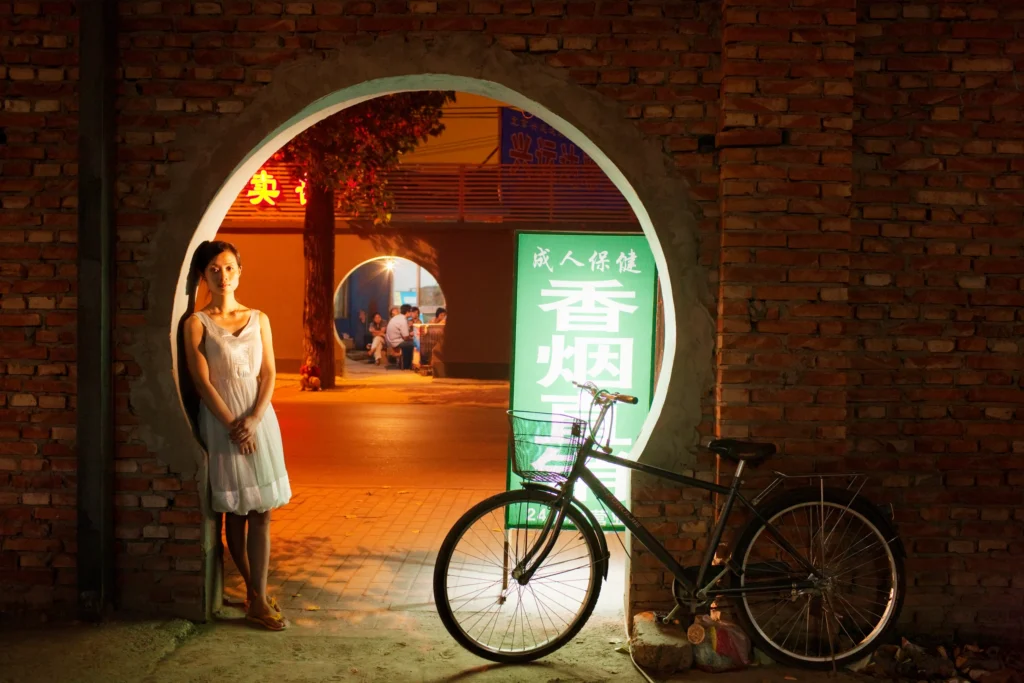
Invited by the city of Beijing to photograph the star ( les stars du/des) stade(s) sportsmen and sportswomen, San Bartolomé prefers consecrating his free time to narrating the modest everyday life of a neighbourhood in the outskirts of Peking and of its craftsmen: for six months he works on this new photo series. All the elements of which will be shown through exhibitions in China under the title Beijing Midsummer Night Dream, later renamed Moon Doors Dreamers (2008-2009 ).

San Bartolomé then goes on to shoot a video film Two Worlds, One Dream freely inspired by the Chinese motto for the Olympic Games: One World, One Dream.

On the occasion of the Ping Yao International Photo Festival, he receives the Prize of Best Foreign Photographer (September 2010) and Frédéric Mitterand, the then French Minister of Culture makes him Chevalier des Arts et Lettres. (French cultural and artistic distinction)

From 2010 onwards, San Bartolomé devotes himself exclusively to photography and the visual arts.

Lorem ipsum dolor sit amet, consectetur adipiscing elit. Ut elit tellus, luctus nec ullamcorper mattis, pulvinar dapibus leo.